Advertisements
Advertisements
Question
How can you find the following?
Velocity from acceleration – time graph.
Advertisements
Solution
Velocity from acceleration – time graph: Area under the acceleration – time graph gives the velocity of the body. When the body moves with variable velocity but uniform acceleration, then acceleration – time graph is a straight line (PQ) parallel to the time axis.
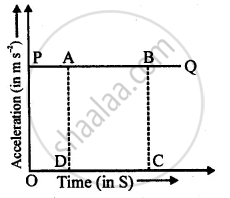
Take any two points A and B on PQ. From P and Q, draw perpendiculars (BC and AD) on the time axis. such that,
OD = t1 and OC = t2
Let OP = AD = BC = a = acceleration of the body.
Area under acceleration – time graph = area of rectangle ABCD
= AD × DC = AD × (OC − OD)
= a (t2 − t1)
= `("v"-"u")/(("t"_2-"t"_1))("t"_2-"t"_1)` = v − u
If initial velocity of the body = u = 0 Then area under acceleration – time graph = v – 0 = v = velocity of the body.
APPEARS IN
RELATED QUESTIONS
Fill in the following blank with suitable word :
Velocity is the rate of change of……………………… It is measured in.............. .
A bus was moving with a speed of 54 km/h. On applying brakes it stopped in 8 seconds. Calculate the acceleration.
A freely falling object travels 4.9 m in 1st second, 14.7 m in 2 nd second, 24.5 m in 3rd second, and so on. This data shows that the motion of a freely falling object is a case of :
The slope of a speed-time graph gives:
When is the negative acceleration?
Multiple choice Question. Select the correct option.
A body dropped from the top of a tower reaches the ground in 4s. Height of the tower is
Can you suggest a real-life example about the motion of a body from the following velocity – time graph?
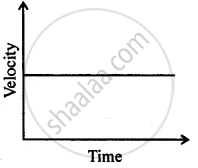
Can you suggest a real-life example about the motion of a body from the following velocity – time graph?
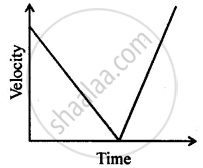
Draw a velocity versus time graph of a stone thrown vertically upwards and then coming downwards after attaining the maximum height.
When will you say a body is at uniform acceleration?
