Advertisements
Advertisements
Question
If a stone and a pencil are dropped simultaneously in vacuum from the top of a tower, then which of the two will reach the ground first? Give reason.
Advertisements
Solution
In vacuum, both will reach the ground simultaneously because acceleration due to gravity is same (=g) on both objects.
APPEARS IN
RELATED QUESTIONS
A train starting from a railway station and moving with uniform acceleration attains a speed 40 km h−1 in 10 minutes. Find its acceleration.
A motorcycle moving with a speed of 5 m/s is subjected to an acceleration of 0.2 m/s2. Calculate the speed of the motorcycle after 10 seconds, and the distance travelled in this time.
A train starting from stationary position and moving with uniform acceleration attains a speed of 36 km per hour in 10 minutes. Find its acceleration.
Which of the following could not be a unit of acceleration?
Give one example of following motion :
Variable acceleration
Write three equations of uniformly accelerated motion relating the initial velocity (u), final velocity (v), time (t), acceleration (a) and displacement (S).
When is the negative acceleration?
Can you suggest a real-life example about the motion of a body from the following velocity – time graph?
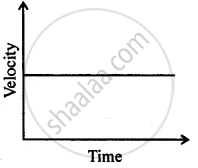
Can you suggest a real-life example about the motion of a body from the following velocity – time graph?
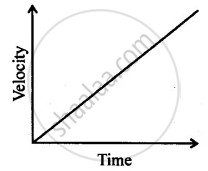
Draw a velocity versus time graph of a stone thrown vertically upwards and then coming downwards after attaining the maximum height.
