Advertisements
Advertisements
Question
A body, initially at rest, starts moving with a constant acceleration 2 m s-2. Calculate: (i) the velocity acquired and (ii) the distance travelled in 5 s.
Advertisements
Solution
Initial velocity u = 0 m/s
Acceleration a = 2 m/s2
Time t = 5 s
(i) Let 'v' be the final velocity.
Then, (v - u)/5 = 2
v = 10 m/s-1
(ii) Let 's' be the distance travelled.
Using the third equation of motion,
v2 - u2 = 2as
We get,
(10) 2 - (0) 2 = 2(2) (s)
Thus, s = (100/4) m = 25 m
APPEARS IN
RELATED QUESTIONS
Name the physical quantity whose SI unit is :
(a) m/s (b) m/s2
A motorcycle moving with a speed of 5 m/s is subjected to an acceleration of 0.2 m/s2. Calculate the speed of the motorcycle after 10 seconds, and the distance travelled in this time.
A car is travelling along the road at 8 ms-1. It accelerates at 1 ms-2 for a distance of 18 m. How fast is it then travelling ?
The slope of a speed-time graph gives:
Define velocity. State its unit.
If a stone and a pencil are dropped simultaneously in vacuum from the top of a tower, then which of the two will reach the ground first? Give reason.
Multiple choice Question. Select the correct option.
A body dropped from the top of a tower reaches the ground in 4s. Height of the tower is
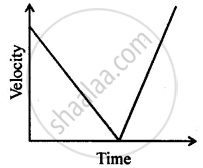
Can you suggest a real-life example about the motion of a body from the following velocity – time graph?
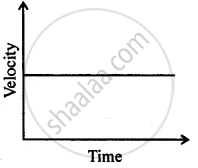
Can you suggest a real-life example about the motion of a body from the following velocity – time graph?
An object starting from rest travels 20 m in the first 2 s and 160 m in the next 4 s. What will be the velocity after 7 s from the start?
