Advertisements
Advertisements
Question
Derive the formula s= `ut+1/2at^2` , where the symbols have usual meanings.
Advertisements
Solution
Suppose a body has an initial velocity ‘u’ and a uniform acceleration’ a’ for time ‘t’ so that its final velocity becomes ‘v’. Let the distance travelled by the body in this time be ‘s’. The distance travelled by a moving body in time ‘t’ can be found out by considering its average velocity. Since the initial velocity of the body is ‘u’ and its final velocity is ‘v’, the average velocity is given by:
APPEARS IN
RELATED QUESTIONS
When will you say a body is at non-uniform acceleration?
Which of the two can be zero under certain conditions : average speed of a moving body or average velocity of a moving body ?
Give one example of a situation in which a body has a certain average speed but its average velocity is zero.
What term is used to denote the change of velocity with time ?
Fill in the following blank with suitable word :
If a body moves with uniform velocity, its acceleration is ..............
A train starting from stationary position and moving with uniform acceleration attains a speed of 36 km per hour in 10 minutes. Find its acceleration.
A boy is sitting on a merry-go-round which is moving with a constant speed of 10 m s−1. This means that the boy is :
When is the positive acceleration?
Can you suggest a real-life example about the motion of a body from the following velocity – time graph?
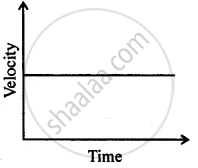
How will the equations of motion for an object moving with a uniform velocity change?
