Advertisements
Advertisements
Question
Find the initial velocity of a car which is stopped in 10 seconds by applying brakes. The retardation due to brakes is 2.5 m/s2.
Advertisements
Solution
We have to find the initial velocity.
Final velocity as the car stops after some time, (v) = 0 m/s
Acceleration for the entire journey, (a) = –2.5 m/s2
Time taken is (t) = 10 s
Let the initial velocity be (u)
We can calculate initial velocity using 1st equation of motion as, u = v – at
So initial velocity,
u = 0 – (–2.5)(10)
⇒ u = 25 m/s
APPEARS IN
RELATED QUESTIONS
What term is used to denote the change of velocity with time ?
Define velocity. What is the SI unit of velocity ?
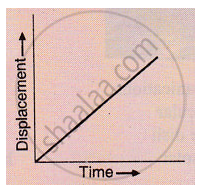
What conclusion can you draw about the velocity of a body from the displacement-time graph shown below :
Define velocity. State its unit.
When is the positive acceleration?
Multiple choice Question. Select the correct option.
At the maximum height, a body thrown vertically upwards has :
How can you find the following?
Acceleration from velocity – time graph.
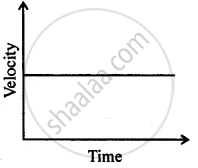
Can you suggest a real-life example about the motion of a body from the following velocity – time graph?
Two stones are thrown vertically upwards simultaneously with their initial velocities u1 and u2 respectively. Prove that the heights reached by them would be in the ratio of `"u"_1^2 : "u"_2^2` (Assume upward acceleration is –g and downward acceleration to be +g)
When will you say a body is at uniform acceleration?
