Advertisements
Advertisements
प्रश्न
Find the initial velocity of a car which is stopped in 10 seconds by applying brakes. The retardation due to brakes is 2.5 m/s2.
Advertisements
उत्तर
We have to find the initial velocity.
Final velocity as the car stops after some time, (v) = 0 m/s
Acceleration for the entire journey, (a) = –2.5 m/s2
Time taken is (t) = 10 s
Let the initial velocity be (u)
We can calculate initial velocity using 1st equation of motion as, u = v – at
So initial velocity,
u = 0 – (–2.5)(10)
⇒ u = 25 m/s
APPEARS IN
संबंधित प्रश्न
Which of the two can be zero under certain conditions : average speed of a moving body or average velocity of a moving body ?
Fill in the following blank with suitable word :
A motorcycle has a steady……………. of 3 m/s2. This means that every………………. its…………….. increases by………….
Fill in the following blank with suitable word :
Velocity is the rate of change of……………………… It is measured in.............. .
A car is travelling along the road at 8 ms-1. It accelerates at 1 ms-2 for a distance of 18 m. How fast is it then travelling ?
A boy is sitting on a merry-go-round which is moving with a constant speed of 10 m s−1. This means that the boy is :
For a uniformly retarded motion, the velocity-time graph is _____________
Derive the following equations for uniformly accelerated motion:
(i) v = u + at
(ii) `"S = ut" + 1/2 "at"^2`
(iii) v2 = u2 + 2aS
where the symbols have their usual meanings.
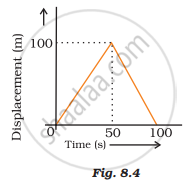
A girl walks along a straight path to drop a letter in the letterbox and comes back to her initial position. Her displacement–time graph is shown in Fig.8.4. Plot a velocity-time graph for the same.
Draw a velocity versus time graph of a stone thrown vertically upwards and then coming downwards after attaining the maximum height.
An object starting from rest travels 20 m in the first 2 s and 160 m in the next 4 s. What will be the velocity after 7 s from the start?
