Advertisements
Advertisements
प्रश्न
A car starting from rest acquires a velocity 180m s-1 in 0.05 h. Find the acceleration.
Advertisements
उत्तर
Here, final velocity = 180 m/s
Initial velocity = 0 m/s
Time taken = 0.05 h or 180 s
Acceleration = (Final Velocity - Initial Velocity)/time
= (180-0)/180 m s-2
= 1 m s-2
APPEARS IN
संबंधित प्रश्न
A bus decreases its speed from 80 km h−1 to 60 km h−1 in 5 s. Find the acceleration of the bus.
A boy is sitting on a merry-go-round which is moving with a constant speed of 10 m s−1. This means that the boy is :
A bus increases its speed from 36 km/h to 72 km/h in 10 seconds. Its acceleration is :
Differentiate between uniform acceleration and variable acceleration.
If a stone and a pencil are dropped simultaneously in vacuum from the top of a tower, then which of the two will reach the ground first? Give reason.
A bicycle initially moving with a velocity 5.0 m s-1 accelerates for 5 s at a rate of 2 m s-2. What will be its final velocity?
When is the negative acceleration?
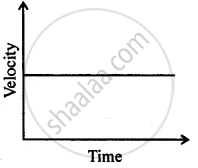
Can you suggest a real-life example about the motion of a body from the following velocity – time graph?
An object starting from rest travels 20 m in the first 2 s and 160 m in the next 4 s. What will be the velocity after 7 s from the start?
When will you say a body is at uniform acceleration?
