Advertisements
Advertisements
प्रश्न
A bus was moving with a speed of 54 km/h. On applying brakes it stopped in 8 seconds. Calculate the acceleration.
Advertisements
उत्तर
(b) We have to find the value of uniform acceleration. So, Initial velocity
(u) = 54 km/hr
= `"54(1000)"/3600` m/s
= 15 m/s
Final velocity (v) = 0 m/s
Time taken(t) = 8 s
So acceleration, `a = (v-u)/t`
Put the values in the above equation to get the value of acceleration
`a = (0-15)/8`
= -`1.875 "m/s"^2`
APPEARS IN
संबंधित प्रश्न
Name the quantity which is measured by the area occupied under the velocity-time graph.
Derive the formula s= `ut+1/2at^2` , where the symbols have usual meanings.
A car starting from rest acquires a velocity 180m s-1 in 0.05 h. Find the acceleration.
A bicycle initially moving with a velocity 5.0 m s-1 accelerates for 5 s at a rate of 2 m s-2. What will be its final velocity?
For a uniformly retarded motion, the velocity-time graph is _____________
A body, initially at rest, starts moving with a constant acceleration 2 m s-2. Calculate: (i) the velocity acquired and (ii) the distance travelled in 5 s.
When is the negative acceleration?
Multiple choice Question. Select the correct option.
At the maximum height, a body thrown vertically upwards has :
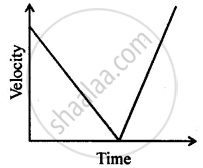
Can you suggest a real-life example about the motion of a body from the following velocity – time graph?
How will the equations of motion for an object moving with a uniform velocity change?
