Advertisements
Advertisements
प्रश्न
Which of the following can sometimes be 'zero' for a moving body?
(i) average velocity
(ii) distance travelled
(iii) average speed
(iv) displacement
विकल्प
only (i)
(i) and (ii)
(i) and (iv)
only (iv)
Advertisements
उत्तर
(i) and (iv)
Distance is the length of the actual path covered by a moving body. This implies that the distance travelled by a moving body and also its average speed can never be zero at any point of time. However, it is possible for the displacement as well as average velocity for the body to be zero at an instance during the motion of the particle.
APPEARS IN
संबंधित प्रश्न
Under what condition(s) is the magnitude of average velocity of an object equal to its average speed?
During an experiment, a signal from a spaceship reached the ground station in five minutes. What was the distance of the spaceship from the ground station? The signal travels at the speed of light, that is, 3 × 10⁸m s−1.
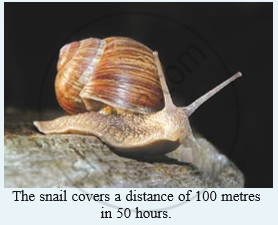
A snail covers a distance of 100 metres in 50 hours. Calculate the average speed of snail in km/h.
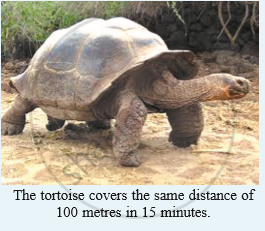
A tortoise moves a distance of 100 metres in 15 minutes. What is the average speed of tortoise in km/h ?
A car is moving on a straight road with uniform acceleration. The speed of the car varies with time as follows :
Time (s) : 0 2 4 6 8 10
Speed (m/s) : 4 8 12 16 20 24
Draw the speed-time graph by choosing a convenient scale. From this graph :
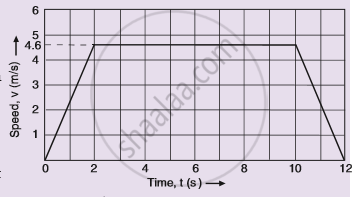
(1) Calculate the acceleration of the car.
(2) Calculate the distance travelled by the car in 10 seconds.
A bus moving along a straight line at 20 m/s undergoes an acceleration of 4 m/s2. After 2 seconds, its speed will be:
Give one example of following motion :
Uniform velocity
Express 15 m s-1 in km h-1.
A car accelerates at a rate of 5 m s-2. Find the increase in its velocity in 2 s.
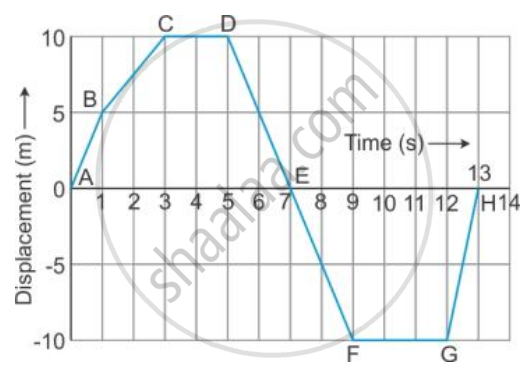
From the displacement-time graph of a cyclist given below in the Figure, find The average velocity in the first 4 s.