Advertisements
Advertisements
प्रश्न
The velocity-time graph of a moving body is given below in Figure
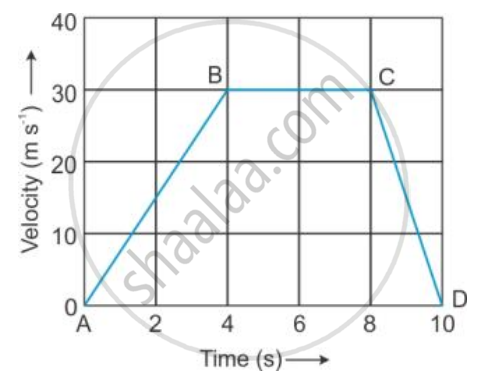
The acceleration in parts AB, BC and CD.
Advertisements
उत्तर
Acceleration in the part AB = Slope of AB
= tan (∠BAD)
= (30/4) ms-2
= 7.5 ms-2
Acceleration in the part BC = 0 ms-2
Acceleration in the part CD = slope of CD = -tan (∠CDA)
= -(30/2) ms-2
= -15 ms-2
APPEARS IN
संबंधित प्रश्न
A car is moving along a straight road at a steady speed. It travels 150 m in 5 seconds:
How far does it travel in 6 seconds ?
Which of the following can sometimes be 'zero' for a moving body?
(i) average velocity
(ii) distance travelled
(iii) average speed
(iv) displacement
A bus moving along a straight line at 20 m/s undergoes an acceleration of 4 m/s2. After 2 seconds, its speed will be:
Give one example of following motion :
Uniform velocity
The speed of a car is 72 km h-1. Express it in m s-1.
A train takes 2 h to reach station B from station A, and then 3 h to return from station B to station A. The distance between the two stations is 200 km. Find:
The average speed,
The average velocity of the train.
For the motion with uniform velocity , how is the distance travelled related to the time ?
What is the relation between distance and time when the body is moving with uniform velocity?
What is the relation between distance and time when the body is moving with variable velocity?
How many variables are present in each equation of motion?
