Advertisements
Advertisements
Question
The velocity-time graph of a moving body is given below in Figure
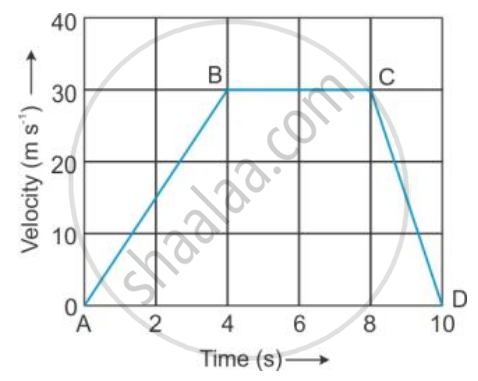
Total displacement.
Advertisements
Solution
Total displacement = Displacement of part AB + Displacement of part BC + Displacement of part CD
= 60 + 120 + 30 = 210 m
APPEARS IN
RELATED QUESTIONS
Abdul, while driving to school, computes the average speed for his trip to be 20 km h−1. On his return trip along the same route, there is less traffic and the average speed is 30 km h−1. What is the average speed for Abdul’s trip?
What name is given to the speed in a specified direction ?
Arrange the following speed in increasing order (keeping the least speed first):
A bicycle moving with a speed of 200 m/min.
Arrange the following speed in increasing order (keeping the least speed first
A scooter moving with a speed of 30 km/h.
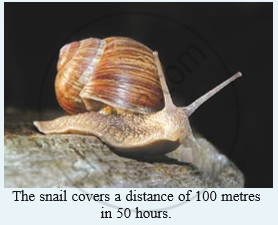
A snail covers a distance of 100 metres in 50 hours. Calculate the average speed of snail in km/h.
A train takes 2 h to reach station B from station A, and then 3 h to return from station B to station A. The distance between the two stations is 200 km. Find:
The average speed,
The average velocity of the train.
For the motion with uniform velocity , how is the distance travelled related to the time ?
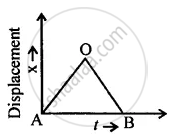
Write down the type of motion of a body along with the A – O – B of the following distance – time graph.
What are the uses of equations of motion?
A motorcyclist drives from A to B with a uniform speed of 30 km h–1 and returns back with a speed of 20 km h–1. Find its average speed.
