Advertisements
Advertisements
प्रश्न
A car is moving in a straight line with speed 18 km h-1. It is stopped in 5 s by applying the brakes. Find:
- the speed of car in m s-1
- the retardation and
- the speed of car after 2 s of applying the brakes.
Advertisements
उत्तर
Given, speed of car = 18 km h-1
(i) To convert speed to m s-1
`18 " km h"^-1 = (18 " km")/(1 " h") = (18 xx 1000 " m")/(60 xx 60 " s")`
`=> 18 " km h"^-1 = (18 xx 10 " m")/(6 xx 6 " s")`
`=> 18 " km h"^-1 = 5 "m s"^-1`
Hence, 18 km h-1 is equal to 5 m s-1.
(ii) As the car is stopped, the final velocity = 0
initial velocity (u) = 18 km h-1
As we know,
Acceleration (a) = `("Final velocity (v)" - "initial velocity (u)")/("time (t)")`
Given, Initial velocity (u) = 5 m s-1
Final velocity (v) = 0
Time (t) = 5 s
Substituting the values in the formula above, we get,
Acceleration (a) = `(0 - 5)/5`
Acceleration (a) = `- 5/5`
Acceleration (a) = - 1 ms-2
Hence, acceleration of the car is -1 m s-2. Negative sign shows that the velocity decreases with time, so retardation is 1 m s -2.
(iii) Given, t = 2 s, a = -1 m s-2, u = 5 m s-1
Substituting the values in the formula for acceleration, we get,
`=> - 1 "ms"^-2 = ((v - 5)"ms"^-1)/(2s)`
`=> -2ms^-1 = (v - 5)ms^-1`
⇒ v = (5 - 2) ms-1
⇒ v = 3 ms-1
Hence, the speed of car after 2 s of applying the brakes = 3 m s-1.
APPEARS IN
संबंधित प्रश्न
During an experiment, a signal from a spaceship reached the ground station in five minutes. What was the distance of the spaceship from the ground station? The signal travels at the speed of light, that is, 3 × 10⁸m s−1.
What do the following measure in a car ?
(a) Speedometer (b) Odometer
Under which condition is the magnitude of average velocity equal to average speed ?
Arrange the following speed in increasing order (keeping the least speed first):
A bicycle moving with a speed of 200 m/min.
The distance between Delhi and Agra is 200 km. A train travels the first 100 km at a speed of 50 km/h. How fast must the train travel the next 100 km, so as to average 70 km/h for the whole journey ?
The tip of seconds’ hand of a dock takes 60 seconds to move once on the circular dial of the clock. If the radius of the dial of the clock be 10.5 cm, calculate the speed of the tip of the seconds’ hand of the clock. `("Given" π= 22/7)`.
The speed of a car is 72 km h-1. Express it in m s-1.
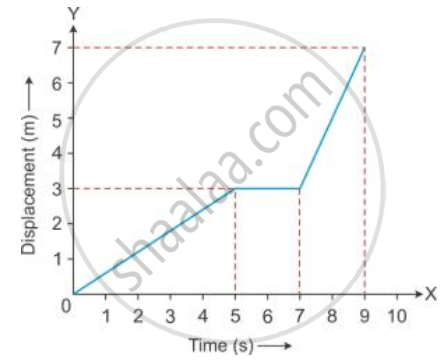
Figure shows the displacement of a body at different times .
Calculate the velocity of the body as it moves for time interval :
(i) 0 to 5 s,
(ii) 5 s to 7 s
(iii) 7 s to 9 s.
Define uniform velocity and give one example.
How many variables are present in each equation of motion?
