Advertisements
Advertisements
प्रश्न
If a sprinter runs a distance of 100 metres in 9.83 seconds, calculate his average speed in km/h.
Advertisements
उत्तर
Distance (d) = 100 m
Time (t) = 9.83 s
So, we can calculate the speed as :
`"Average speed" = "Total distance travelled"/"Time"`
Average speed for the entire journey :
= `100/9.83`
= 10.173 m/s
Now , we can convert it in km/h as :
= `((10.173)(3600))/1000`
= 36.62 km/hr
APPEARS IN
संबंधित प्रश्न
What name is given to the speed in a specified direction ?
Arrange the following speed in increasing order (keeping the least speed first):
An athlete running with a speed of 10 m/s.
Arrange the following speed in increasing order (keeping the least speed first):
A bicycle moving with a speed of 200 m/min.
A car is moving along a straight road at a steady speed. It travels 150 m in 5 seconds:
How long does it take to travel 240 m ?
Give an example of the motion of a body moving with a constant speed but with a variable velocity. Draw a diagram to represent such a motion.
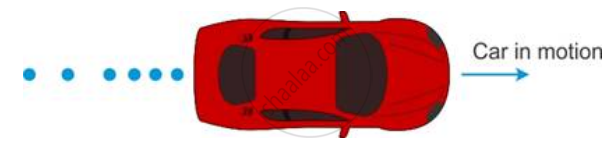
The diagram below shows the pattern of the oil on the road at a constant rate from a moving car. What information do you get from it about the motion of the car.
A car travels the first 30 km with a uniform speed of 60 km h−1 and the next 30 km with a uniform speed of 40 km h−1. Calculate :
- The total time of journey,
- The average speed of the car.
A car is moving with a velocity 20 m s-1. The brakes are applied to retard it at a rate of 2 m s-2. What will be the velocity after 5 s of applying the brakes?
Give two examples of uniform circular motion from your daily life.
A motorcyclist drives from A to B with a uniform speed of 30 km h–1 and returns back with a speed of 20 km h–1. Find its average speed.
