Advertisements
Advertisements
Question
A body projected vertically up with a velocity of 10 m/s reaches a height of 20 m. If it is projected with a velocity of 20 m/s, then the maximum height reached by the body is:
Options
20 m
10 m
80 m
40 m
Advertisements
Solution
80 m
Explanation:
Initial velocity = u = 10 m/s
Height = Distance = S = 20 m
At highest point, Final velocity = v = 0
Acceleration = (a) = ?
Case − I
v2 − u2 = 2aS
(0)2 − (10)2 = 2a (20)
a = `-100/40` = −2.5 ms−2
Case – II
u = 20 m/s; v = 0
a = −2.5 ms−2; S = h /
v2 − u2 = 2aS
(0)2 − (20)2 = 2(−2.5)h
h = `400/5` = 80 m
APPEARS IN
RELATED QUESTIONS
Change the speed of 6 m/s into km/h.
Name the physical quantity which gives us an idea of how slow or fast a body is moving.
Under which condition is the magnitude of average velocity equal to average speed ?
Bus X travels a distance of 360 km in 5 hours whereas bus Y travels a distance of 476 km in 7 hours. Which
bus travels faster ?
Arrange the following speed in increasing order (keeping the least speed first
A scooter moving with a speed of 30 km/h.
Which of the following statement is correct regarding velocity and speed of a moving body?
Which of the following could not be a unit of speed?
A train takes 2 h to reach station B from station A, and then 3 h to return from station B to station A. The distance between the two stations is 200 km. Find:
The average speed,
The average velocity of the train.
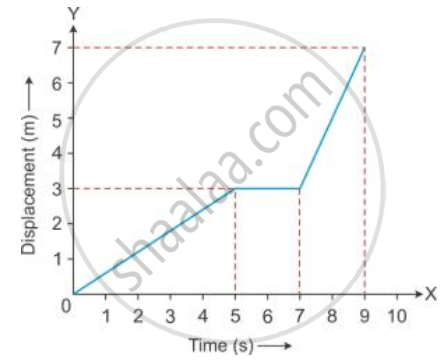
Figure shows the displacement of a body at different times .
Calculate the velocity of the body as it moves for time interval :
(i) 0 to 5 s,
(ii) 5 s to 7 s
(iii) 7 s to 9 s.
A motorcyclist drives from A to B with a uniform speed of 30 km h–1 and returns back with a speed of 20 km h–1. Find its average speed.
