Advertisements
Advertisements
Question
Give two examples of uniform circular motion from your daily life.
Advertisements
Solution
(i) Motion of blades of an electric fan.
(ii) Motion of moon around earth.
APPEARS IN
RELATED QUESTIONS
What is the SI unit of retardation ?
Arrange the following speed in increasing order (keeping the least speed first
A scooter moving with a speed of 30 km/h.
The distance between Delhi and Agra is 200 km. A train travels the first 100 km at a speed of 50 km/h. How fast must the train travel the next 100 km, so as to average 70 km/h for the whole journey ?
A train starting from rest moves with a uniform acceleration of 0.2 m/s2 for 5 minutes. Calculate the speed acquired and the distance travelled in this time.
The graph given alongside shows how the speed of a car changes with time:
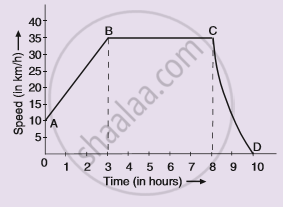
(i) What is the initial speed of the car ?
(ii) What is the maximum speed attained by the car ?
(iii) Which part of the graph shows zero acceleration ?
(iv) Which part of the graph shows varying retardation ?
(v) Find the distance travelled in first 8 hours.
Give one example of following motion :
Uniform velocity
A car accelerates at a rate of 5 m s-2. Find the increase in its velocity in 2 s.
A train is moving with a velocity of 90 km h-1 . It is brought to stop by applying the brakes which produce a retardation of 0.5 ms-2 Find :
(i) The velocity after 10 s , and
(ii) the time taken by the train to come to rest .
A speeding car changes its velocity from 108 kmh−1 to 36 kmh−1 in 4 s. Calculate its deceleration in
- ms−2
- kmh−2.
A body projected vertically up with a velocity of 10 m/s reaches a height of 20 m. If it is projected with a velocity of 20 m/s, then the maximum height reached by the body is:
