Advertisements
Advertisements
Question
What is the difference between distance travelled by a body and its displacement ? Explain with the
help of a diagram.
Advertisements
Solution
| Distance | Displacement |
| 1.Distance has only magnitude, with no specified direction. | 1.Displacement has magnitude as well as direction. |
| 2.It is a scalar quantity. | 2.It is a vector quantity. |
| 3.Two different distances can be added directly. | 3.We have to follow the vector addition method to add displacements. |
One difference in diagrammatic form is as follows:
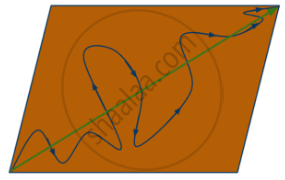
Here the curved line is the distance traveled and the straight line is the magnitude of the displacement.
APPEARS IN
RELATED QUESTIONS
Is displacement a scalar quantity?
If the displacement of an object is proportional to the square of time, then the object is moving with :
How is the distance related with time for motion under uniform acceleration such as the motion of a freely falling body?
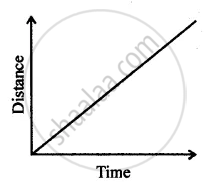
Can you suggest the kind of motion of a body from the following distance – time graph?
A motorbike running at 90 kmh−1, is slowed down to 54 kmh−1 by the application of brakes, over a distance of 40 m. If the brakes are applied with the same force, calculate
- total time in which bike comes to rest
- total distance travelled by bike.
Name the physical quantity associated with the rate of change of displacement with time.
A particle moves along a circular path. How many times does it change its direction in two complete rounds?
The SI unit of displacement is ______.
A scalar quantity has ______.
If the displacement-time graph of a particle is parallel to the time axis, the velocity of the particle is ______.
