Advertisements
Advertisements
प्रश्न
What is the difference between distance travelled by a body and its displacement ? Explain with the
help of a diagram.
Advertisements
उत्तर
| Distance | Displacement |
| 1.Distance has only magnitude, with no specified direction. | 1.Displacement has magnitude as well as direction. |
| 2.It is a scalar quantity. | 2.It is a vector quantity. |
| 3.Two different distances can be added directly. | 3.We have to follow the vector addition method to add displacements. |
One difference in diagrammatic form is as follows:
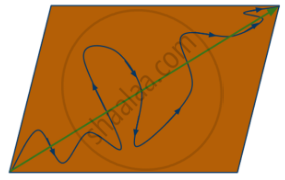
Here the curved line is the distance traveled and the straight line is the magnitude of the displacement.
APPEARS IN
संबंधित प्रश्न
An ant travels a distance of 8 cm from P to Q and then moves a distance of 6 cm at right angles to PQ. Find its resultant displacement.
What information about the motion of a body are obtained from the displacement-time graph?
Figure given below shows a velocity-time graph for a car starting from rest. The graph has three parts AB, BC and CD.
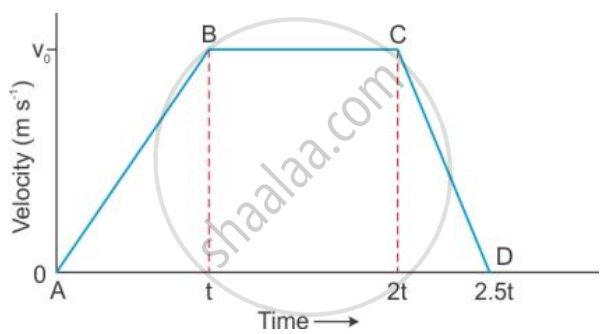
Compare the distance travelled in part BC with the distance travelled in part AB.
A racehorse runs straight towards the north and covers 540 m in one minute. Calculate
- displacement of the horse,
- its velocity in (a) ms−1 (b) kmh−1.
A body is moving along a circular path of radius r. What will be the distance and displacement of the body when it completes:
Full revolution
A body is moving along a circular path of radius r. What will be the distance and displacement of the body when it completes:
Two full revolutions
A body moves along a circular path of radius r. When it completes three complete rounds, what is the ratio of distance covered to its displacement?
The table below shows the distance travelled by two vehicles A and B during each second:
| Time (s) | 0 | 1 | 2 | 3 | 4 | 5 | 6 | 7 |
| Distance travelled by A (m) | 0 | 20 | 80 | 180 | 240 | 300 | 360 | 420 |
| Distance travelled by B (m) | 0 | 10 | 40 | 90 | 160 | 250 | 360 | 490 |
Give the value of the velocity at which they are meeting
The shortest distance between two places is ______.
______ is the length of the actual path covered by a body.
