Advertisements
Advertisements
प्रश्न
An ant travels a distance of 8 cm from P to Q and then moves a distance of 6 cm at right angles to PQ. Find its resultant displacement.
Advertisements
उत्तर १
We have to find the resultant displacement from the given diagram :
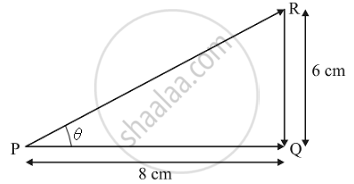
We have:
PQ = 8 cm and QR = 6 cm
Resultant displacement :
`PR = sqrt(PQ^2 + QR^2)`
= `sqrt(64+36)`
= `sqrt(100)`
= 10 cm
The direction of this displacement is from P to R. If θ is the angle made by PR with PQ then,'
`tan θ = "RQ"/"PQ"`
⇒ `tan θ = 36/64`
⇒ `θ = tan^-1 0.5625`
⇒ `θ = 29.36^circ`
This is the angle made by the resultant with PQ.
उत्तर २
To find the resultant displacement, we treat the movement of the ant as forming a right triangle, where:
- The distance from P to Q is 8 cm (one leg of the triangle).
- The distance moved at a right angle to PQ is 6 cm (the other leg of the triangle).
The resultant displacement is the hypotenuse of this right triangle, which can be calculated using the Pythagorean theorem:
Resultant displacement = `sqrt((8^2 + 6^2)`
Resultant displacement = `sqrt(64+36) = sqrt100 = 10 cm.`
The resultant displacement is 10 cm.
APPEARS IN
संबंधित प्रश्न
State whether distance is a scalar or a vector quantity.
Under what conditions can a body travel a certain distance and yet its resultant displacement be zero ?
What is the difference between distance travelled by a body and its displacement ? Explain with the
help of a diagram.
If on a round trip you travel 6 km and then arrive back home :
What distance have you travelled ?
What can you say about the nature of motion of a body if its displacement-time graph is A straight line inclined to the time axis with an obtuse angle?
The figure represents graphically the velocity of a car moving along a straight road over a period of 100 hours.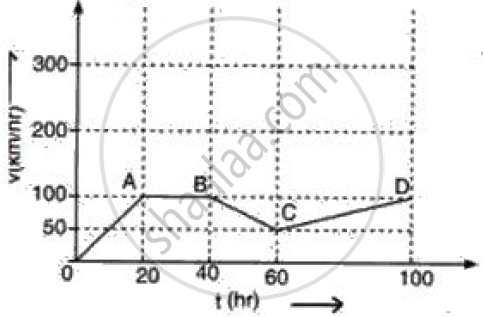
Calculate the distance travelled in the last 40 h.
An object covers a distance of S meters in t seconds as follows :
| S (meters) | 0 | 8 | 20 | 20 | 16 | 10 | 0 |
| t (Seconds) | 80 | 2 | 5 | 10 | 12 | 15 | 10 |
Plot a graph, taking t on X-axis and S on Y-axis. Determine the velocity of the object at time
(i) 6 s, and
(ii) 14 s.
Which of the following is correct?
Using the following data, draw time - displacement graph for a moving object:
| Time (s) | 0 | 2 | 4 | 6 | 8 | 10 | 12 | 14 | 16 |
| Displacement (m) | 0 | 2 | 4 | 4 | 4 | 6 | 4 | 2 | 0 |
Use this graph to find average velocity for the first 4 s, for the next 4 s and for the last 6 s.
Obtain a relation for the distance travelled by an object moving with uniform acceleration in the interval between 4th and 5th seconds.
