Advertisements
Advertisements
Question
A car travels a distance 100 m with constant acceleration and average velocity of 20 ms-1. The final velocity acquired by the car is 25 ms-1.
Find
(i) The initial velocity.
(ii) Acceleration of the car.
Advertisements
Solution
Distance travelled s = 100 m
Average velocity V = 20 m/s
Final velocity v = 25 m/s
(i) Let u be the initial velocity.
Average velocity = (Initial velocity + Final velocity)/2
V = (u + v)/2
20 = (u + 25)/2
u = 40 - 25 = 15 m/s-1
(ii) Let 'a' be the acceleration of the car.
Using the third equation of motion,
v2 - u2 = 2as
We get,
(25) 2 - (15) 2 = 2 (a) (100)
625 - 225 = 200 a
a = (400/200) m/s2 = 2 m/s-2
APPEARS IN
RELATED QUESTIONS
Fill in the following blank with suitable word :
Displacement is a…………………… quantity whereas distance is a………………………….
What can you say about the nature of motion of a body if its displacement-time graph is A straight line parallel to the time axis?
The following table gives the displacement of a car at different instants of time.
| Time (s) | 0 | 1 | 2 | 3 | 4 |
| Displacement (m) | 0 | 5 | 10 | 15 | 20 |
- Draw the displacement-time sketch and find the average velocity of the car.
- What will be the displacement of the car at (i) 2.5 s and (ii) 4.5 s?
Figure given below shows a velocity-time graph for a car starting from rest. The graph has three parts AB, BC and CD.
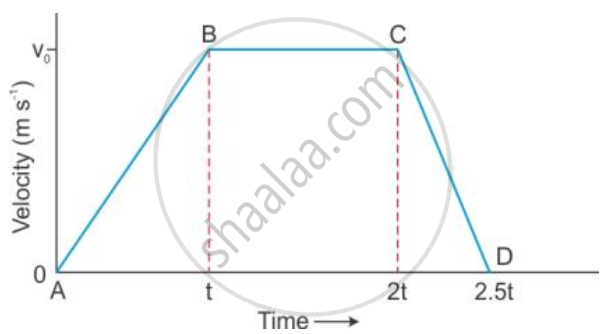
Compare the distance travelled in part BC with the distance travelled in part AB.
Write an expression for the distance S covered in time t by a body which is initially at rest and starts moving with a constant acceleration a.
Explain the following concept in your own words with everyday examples:
Distance
A 50 m long train passes over a bridge at a speed of 30 km/h. If it takes 36 seconds to cross the bridge, calculate the length of the bridge.
Fill in the boxes.
| S.No | First Move | Seconde Move | Distance (m) | Displacement |
| 1. | Move 4 metres east | Move 2 metres west | 6 | 2 m east |
| 2. | Move 4 metres north | Move 2 metres south | ||
| 3. | Move 2 metres east | Move 4 metres west | ||
| 4. | Move 5 metres east | Move 5 metres west | ||
| 5. | Move 5 metres south | Move 2 metres north | ||
| 6. | Move 10 metres west | Move 3 metres east |
Slope of a velocity-time graph gives
A quantity that has both magnitude and direction is ______.
