Advertisements
Advertisements
Question
The displacement of a moving object in a given interval of time is zero. Would the distance travelled by the object also be zero? Justify your answer.
Advertisements
Solution
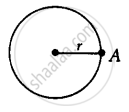
In a given interval of time, the displacement of a moving object is zero when its final position is the same as the initial position, whereas the distance travelled by the object is not zero. For example, an athlete moving on a circular track. If he starts from A and completes one round and reaches back to point A, his displacement is zero whereas the distance travelled by him is not zero but 2πr.
APPEARS IN
RELATED QUESTIONS
What is the difference between distance travelled by a body and its displacement ? Explain with the
help of a diagram.
An ant travels a distance of 8 cm from P to Q and then moves a distance of 6 cm at right angles to PQ. Find its resultant displacement.
Define Displacement.
Give an example of a body which covers a certain distance, but its displacement is zero.
How can you find the following?
Displacement from velocity – time graph.
Calculate the distance and displacement in the following case: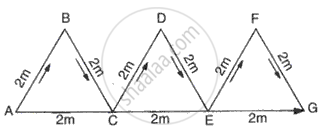
An object covers a distance of S meters in t seconds as follows :
| S (meters) | 0 | 8 | 20 | 20 | 16 | 10 | 0 |
| t (Seconds) | 80 | 2 | 5 | 10 | 12 | 15 | 10 |
Plot a graph, taking t on X-axis and S on Y-axis. Determine the velocity of the object at time
(i) 6 s, and
(ii) 14 s.
The table below shows the distance travelled by two vehicles A and B during each second:
| Time (s) | 0 | 1 | 2 | 3 | 4 | 5 | 6 | 7 |
| Distance travelled by A (m) | 0 | 20 | 80 | 180 | 240 | 300 | 360 | 420 |
| Distance travelled by B (m) | 0 | 10 | 40 | 90 | 160 | 250 | 360 | 490 |
Which vehicle is moving with uniform velocity?
______ is the length of the actual path covered by a body.
Displacement can be zero but distance never.
