मराठी

The displacement of a moving object in a given interval of time is zero. Would the distance travelled by the object also be zero? Justify you answer.

Advertisements
Advertisements

प्रश्न

The displacement of a moving object in a given interval of time is zero. Would the distance travelled by the object also be zero? Justify your answer.

थोडक्यात उत्तर
Advertisements

उत्तर

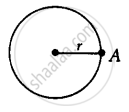
In a given interval of time, the displacement of a moving object is zero when its final position is the same as the initial position, whereas the distance travelled by the object is not zero. For example, an athlete moving on a circular track. If he starts from A and completes one round and reaches back to point A, his displacement is zero whereas the distance travelled by him is not zero but 2πr.
shaalaa.com
  या प्रश्नात किंवा उत्तरात काही त्रुटी आहे का?
पाठ 8: Motion - Short Answer Questions [पृष्ठ ५९]

APPEARS IN

एनसीईआरटी एक्झांप्लर Science Exemplar [English] Class 9
पाठ 8 Motion
Short Answer Questions | Q 12. | पृष्ठ ५९

व्हिडिओ ट्यूटोरियलVIEW ALL [1]

संबंधित प्रश्‍न

Under what conditions can a body travel a certain distance and yet its resultant displacement be zero ?


A body travels a distance of 3 km towards East, then 4 km towards North and finally 9 km towards East.

What is the total distance travelled ?


Figure shows the displacement-time graph of two vehicles A and B moving along a straight road. Which vehicle is moving faster? Give reason.


A body is moving in a straight line and its displacement at various instants of time is given in the following table 

Time (s) 0 1 2 3 4 5 6 7
Displacement (m) 2 6 12 12 12 18 22 24

Plot the displacement-time graph and calculate

(i) Total distance travelled in the interval 1 s to 5 s.

(ii) Average velocity in time interval 1 s to 5 s.


Figure ahead represents the displacement - time sketch of motion of two cars A and B . Find : 
(i) the distance by which the car B was initially ahead of car A.
(ii) the velocities of car A and car B.
(iii) the time in which car A catches car B.
(iv) the distance from start when the car A will catch the car B.


From the displacement – time graph shown given below calculate :

  1. Velocity between 0 – 2 s.
  2. Velocity between 8 s – 12 s.
  3. Average velocity between 5 s – 12 s.


An object covers a distance of S meters in t seconds as follows :

S (meters) 0 8 20 20 16 10 0
t (Seconds) 80 2 5 10 12 15 10

Plot a graph, taking t on X-axis and S on Y-axis. Determine the velocity of the object at time
(i) 6 s, and
(ii) 14 s.


The table below shows the distance travelled by two vehicles A and B during each second:

Time (s) 0 1 2 3 4 5 6 7
Distance travelled by A (m) 0 20 80 180 240 300 360 420
Distance travelled by B (m) 0 10 40 90 160 250 360 490

Which vehicle is ahead at the end of 7th second and by how much?


Fill in the boxes.

S.No First Move Seconde Move Distance (m) Displacement
1. Move 4 metres east Move 2 metres west 2 m east
2. Move 4 metres north Move 2 metres south    
3. Move 2 metres east Move 4 metres west    
4. Move 5 metres east Move 5 metres west    
5. Move 5 metres south Move 2 metres north    
6. Move 10 metres west Move 3 metres east    

Displacement magnitude can be greater than the distance traveled by the object.


Share
Notifications

Englishहिंदीमराठी


      Forgot password?
Use app×