Advertisements
Advertisements
Question
Can displacement be zero even if the distance is not zero? Give one example to explain your answer.
Advertisements
Solution
Yes, displacement can be zero even if the distance is not zero.
For example, when a body is thrown vertically upwards from a point A on the ground, after sometime it comes back to the same point A. Then, the displacement is zero, but the distance travelled by the body is not zero (it is 2h; h is the maximum height attained by the body).
APPEARS IN
RELATED QUESTIONS
A body travels a distance of 3 km towards East, then 4 km towards North and finally 9 km towards East.
What is the resultant displacement ?
A train takes 3 h to travel from Agra to Delhi with a uniform speed of 65 km h-1. Find the distance between the two cities.
Figure shows the velocity-time graph of a particle moving in a straight line.
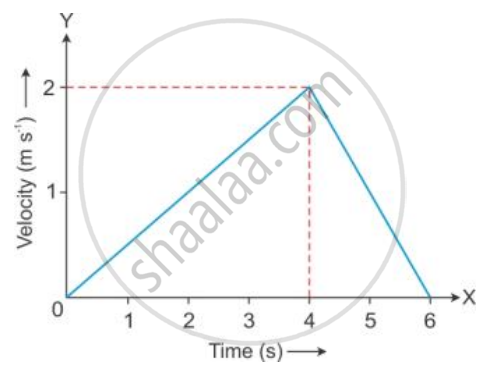
(i) State the nature of motion of particle.
(ii) Find the displacement of particle at t = 6 s.
(iii) Does the particle change its direction of motion?
(iv) Compare the distance travelled by the particle from 0 to 4 s and from 4 s to 6 s.
(v) Find the acceleration from 0 to 4 s and retardation from 4 s to 6 s.
Define Distance.
How can you find the following?
Displacement from velocity – time graph.
Geetha takes 15 minutes from her house to reach her school on a bicycle. If the bicycle has a speed of 2 m/s, calculate the distance between her house and the school.
Assertion: Displacement of a body may be zero when distance travelled by it is not zero.
Reason: The displacement is the shortest distance between initial and final position.
Give one example where the displacement is zero but the distance travelled is not zero.
The displacement of a moving object in a given interval of time is zero. Would the distance travelled by the object also be zero? Justify your answer.
Choose the correct option.
