Advertisements
Advertisements
Question
Figure shows the velocity-time graph of a particle moving in a straight line.
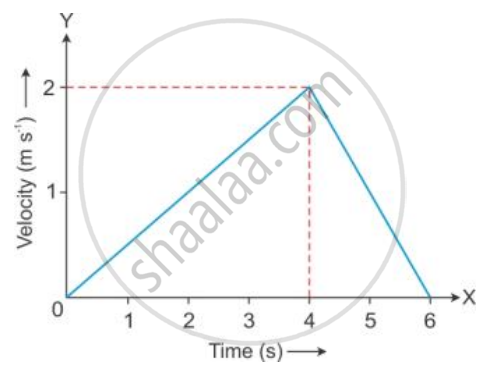
(i) State the nature of motion of particle.
(ii) Find the displacement of particle at t = 6 s.
(iii) Does the particle change its direction of motion?
(iv) Compare the distance travelled by the particle from 0 to 4 s and from 4 s to 6 s.
(v) Find the acceleration from 0 to 4 s and retardation from 4 s to 6 s.
Advertisements
Solution
(i) From 0 to 4 seconds, the motion is uniformly accelerated and from 4 to 6 seconds, the motion is uniformly retarded.
(ii) Displacement of the particle at 6 s = (1/2) (6) (2) = 6 m
(iii) The particle does not change its direction of motion.
(iv) Distance travelled by the particle from 0 to 4s (D1) = (1/2) (4) (2) = 4 m
Distance travelled by the particle from 4 to 6s (D2) = (1/2) (2) (2) = 2 m
D1:D2:: 4:2
D1:D2:: 2:1
(v) Acceleration from 0 to 4 s = (2/4) ms-2 or 0.5 ms-2
Retardation from 4 s to 6 s = (2/2) ms-2 or 1 ms-2.
APPEARS IN
RELATED QUESTIONS
Is displacement a scalar quantity ?
If on a round trip you travel 6 km and then arrive back home :
What distance have you travelled ?
The numerical ratio of displacement to distance for a moving object is :
Give two differences between displacement and distance.
A motorbike running at 90 kmh−1, is slowed down to 54 kmh−1 by the application of brakes, over a distance of 40 m. If the brakes are applied with the same force, calculate
- total time in which bike comes to rest
- total distance travelled by bike.
An object is thrown vertically upwards. It rises upto a height H and then returns to its initial position. Calculate
The displacement of the object.
The table below shows the distance travelled by two vehicles A and B during each second:
| Time (s) | 0 | 1 | 2 | 3 | 4 | 5 | 6 | 7 |
| Distance travelled by A (m) | 0 | 20 | 80 | 180 | 240 | 300 | 360 | 420 |
| Distance travelled by B (m) | 0 | 10 | 40 | 90 | 160 | 250 | 360 | 490 |
Which vehicle is moving with a constant acceleration?
Fill in the boxes.
| S.No | First Move | Seconde Move | Distance (m) | Displacement |
| 1. | Move 4 metres east | Move 2 metres west | 6 | 2 m east |
| 2. | Move 4 metres north | Move 2 metres south | ||
| 3. | Move 2 metres east | Move 4 metres west | ||
| 4. | Move 5 metres east | Move 5 metres west | ||
| 5. | Move 5 metres south | Move 2 metres north | ||
| 6. | Move 10 metres west | Move 3 metres east |
A scalar quantity has ______.
A body is projected up with an initial velocity of u m/s. It goes up to a height, ‘h’ meters in seconds' time. Then it comes back at the point of projection.
Considering negligible air resistance, which of the following statement is true?
