Advertisements
Advertisements
Question
The table below shows the distance travelled by two vehicles A and B during each second:
| Time (s) | 0 | 1 | 2 | 3 | 4 | 5 | 6 | 7 |
| Distance travelled by A (m) | 0 | 20 | 80 | 180 | 240 | 300 | 360 | 420 |
| Distance travelled by B (m) | 0 | 10 | 40 | 90 | 160 | 250 | 360 | 490 |
Which vehicle is moving with a constant acceleration?
Advertisements
Solution
Vehicle B is moving with constant acceleration.
APPEARS IN
RELATED QUESTIONS
The minimum distance between the start and finish points of the motion of an object is called the ______ of the object.
Figure shows the velocity-time graph of a particle moving in a straight line.
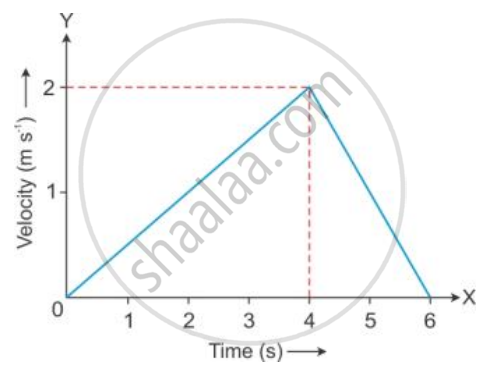
(i) State the nature of motion of particle.
(ii) Find the displacement of particle at t = 6 s.
(iii) Does the particle change its direction of motion?
(iv) Compare the distance travelled by the particle from 0 to 4 s and from 4 s to 6 s.
(v) Find the acceleration from 0 to 4 s and retardation from 4 s to 6 s.
Calculate the distance and displacement in the following case: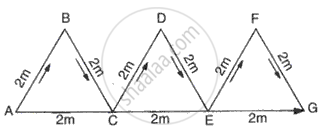
A body is moving along a circular path of radius r. What will be the distance and displacement of the body when it completes:
Half a revolution
A particle moves along a circular path. How many times does it change its direction in two complete rounds?
An object covers a distance of S meters in t seconds as follows :
| S (meters) | 0 | 8 | 20 | 20 | 16 | 10 | 0 |
| t (Seconds) | 80 | 2 | 5 | 10 | 12 | 15 | 10 |
Plot a graph, taking t on X-axis and S on Y-axis. Determine the velocity of the object at time
(i) 6 s, and
(ii) 14 s.
Geetha takes 15 minutes from her house to reach her school on a bicycle. If the bicycle has a speed of 2 m/s, calculate the distance between her house and the school.
Fill in the boxes.
| S.No | First Move | Seconde Move | Distance (m) | Displacement |
| 1. | Move 4 metres east | Move 2 metres west | 6 | 2 m east |
| 2. | Move 4 metres north | Move 2 metres south | ||
| 3. | Move 2 metres east | Move 4 metres west | ||
| 4. | Move 5 metres east | Move 5 metres west | ||
| 5. | Move 5 metres south | Move 2 metres north | ||
| 6. | Move 10 metres west | Move 3 metres east |
Distance is a ______ quantity.
Using the following data, draw time - displacement graph for a moving object:
| Time (s) | 0 | 2 | 4 | 6 | 8 | 10 | 12 | 14 | 16 |
| Displacement (m) | 0 | 2 | 4 | 4 | 4 | 6 | 4 | 2 | 0 |
Use this graph to find average velocity for the first 4 s, for the next 4 s and for the last 6 s.
