Advertisements
Advertisements
Question
Fill in the boxes.
| S.No | First Move | Seconde Move | Distance (m) | Displacement |
| 1. | Move 4 metres east | Move 2 metres west | 6 | 2 m east |
| 2. | Move 4 metres north | Move 2 metres south | ||
| 3. | Move 2 metres east | Move 4 metres west | ||
| 4. | Move 5 metres east | Move 5 metres west | ||
| 5. | Move 5 metres south | Move 2 metres north | ||
| 6. | Move 10 metres west | Move 3 metres east |
Advertisements
Solution
| S.No | First Move | Seconde Move | Distance (m) | Displacement |
| 1. | Move 4 metres east | Move 2 metres west | 6 m | 2 m east |
| 2. | Move 4 metres north | Move 2 metres south | 6 m | 2 m north |
| 3. | Move 2 metres east | Move 4 metres west | 6 m | 2 m west |
| 4. | Move 5 metres east | Move 5 metres west | 10 m | 0 (same place) |
| 5. | Move 5 metres south | Move 2 metres north | 7 m | 3 m south |
| 6. | Move 10 metres west | Move 3 metres east | 13 m | 7 m west |
APPEARS IN
RELATED QUESTIONS
A body is moving along a circular path of radius R. What will be the distance travelled and displacement of the body when it completes half a revolution ?
When brakes are applied to a bus, retardation produced is 25 cm s-2 and the bus takes 20 s to stop. Calculate -
- The initial velocity of the bus
- The distance travelled by bus during this time.
Give an example of a body which covers a certain distance, but its displacement is zero.
Draw displacement – time graph for the following situation:
When a body is moving with uniform velocity.
How can you find the following?
Velocity from a displacement – time graph.
Can distance covered by a body be less than the magnitude of its displacement?
A body is moving along a circular path of radius r. What will be the distance and displacement of the body when it completes:
Full revolution
The graph shows how the velocity of a scooter varies with time in 50 s.
Work out: The distance traveled in 10 s, 20 s, and 50 s.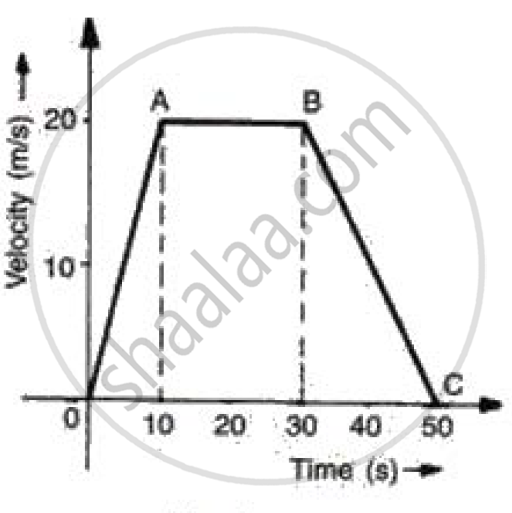
A 50 m long train passes over a bridge at a speed of 30 km/h. If it takes 36 seconds to cross the bridge, calculate the length of the bridge.
Choose the correct option.
