Advertisements
Advertisements
Question
A 50 m long train passes over a bridge at a speed of 30 km/h. If it takes 36 seconds to cross the bridge, calculate the length of the bridge.
Advertisements
Solution
Speed of train = 30 km/hr.
Speed in m/s = ( 30 X1000 )/3600 = 50/6 m/s.
Length of train = 50 m.
Let the length of the bridge be s metre.
The train has to cover a total distance of 50 +s to cross that bridge.
Time taken by train to cover this distance = 36 sec.
So as time taken = total distance /total time taken.
36 = ( 50 +s ) X 6/ 50.
1800 = 300 + 6s
6s = 1500.
S = 1500/6 = 250m
Length of bridge is 250 m.
APPEARS IN
RELATED QUESTIONS
Under what conditions can a body travel a certain distance and yet its resultant displacement be zero ?
What can you say about the nature of motion of a body if its displacement-time graph is A straight line parallel to the time axis?
How is the distance related with time for motion under uniform acceleration such as the motion of a freely falling body?
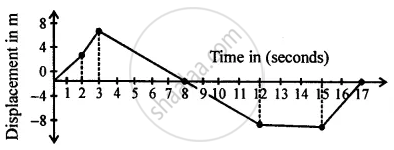
From the displacement – time graph shown given below calculate:
- Average velocity in the first three seconds.
- Displacement from the initial position at the end of 13 s.
- Time after which the body is at the initial position,
- Average velocity after 8 s.
Calculate the distance and displacement in the following case: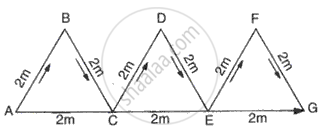
A body is moving along a circular path of radius r. What will be the distance and displacement of the body when it completes:
`(3/4)` th of a revolution
A body is moving along a circular path of radius r. What will be the distance and displacement of the body when it completes:
Two full revolutions
Give the name of the physical quantity that corresponds to the rate of change of displacement.
In which of the following cases of motions, the distance moved and the magnitude of displacement are equal?
A body is projected up with an initial velocity of u m/s. It goes up to a height, ‘h’ meters in seconds' time. Then it comes back at the point of projection.
Considering negligible air resistance, which of the following statement is true?
