Advertisements
Advertisements
Question
A train travels the first 30km of its journey at 30km/h. Find the speed it should travel the next 90km to have an average speed of 60km/h.
Advertisements
Solution
The train travels the first 30 km at speed of 30 km/hr.
Time taken by train to cover this distance is = distance/speed = 30/30 = 1 hr.
Let the speed of the train to cover the next 90 km is v.
Then time taken by train to cover this 90 km is 90/v.
Total time becomes T = 1 +90/v = ( v + 90)/v.
Total distance= 120 km.
Average speed = 60 km/h (given)
However average is given by = total distance /total time.
So (120 x v)/(v +90) = 60
120 v = 60v +5400
60v = 5400
v= 5400/60 =90 km/hr.
so train has to cover those 90 km at a speed of 90 km/hr.
APPEARS IN
RELATED QUESTIONS
Arrange the following speeds in the increasing order:
(i) A bicycle moving with a speed of 36 km/h.
(ii) A car moving with a speed of 2 km/min.
(iii) An athlete running with a speed of 7 m/s.
Does uniform speed mean constant speed?
Can the speed of a body be negative?
During circular motion, which physical quantity of the body:
Remains constant
A body covers half the distance with the speed A and the other half with speed B. What will be the average speed for the whole journey?
In figure the position of a body times is shown . Calculate the speed of the body as it moves from 0 to A, A to B, B to C and i ts average speed .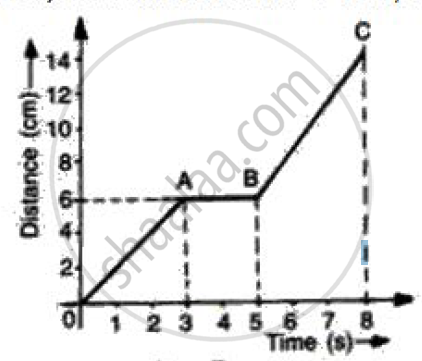
Asher says all objects having uniform speed need not have uniform velocity. Give reason.
Distances between two cities are measured in kilometres.
Assertion: The speed of a body can be Negative.
Reason: If the body is moving in the opposite direction of positive motion, then its speed is Negative.
Distinguish between speed and velocity.
