Advertisements
Advertisements
Question
A girl had designed a clap switch for a science exhibition that enabled her to switch on or off an alarm just with clapping of hands. While testing her device in a hall, she noticed that once the alarm has sounded it followed with another one due to echo of the clap, that is, the sound reflected by the walls. She recorded the two soundings of alarm with her tape recorder and found out that time difference in between them is 0.1 s. If the distance of the walls be 15 m, calculate the speed of sound.
Advertisements
Solution
Time difference of 0.1 s denotes the time taken by sound to go from device to wall and back to wall. As the distance between wall and device is 15 m so total distance covered by sound is 2 X 15 m =30 m.
So speed of sound is = total distance covered/time taken = 30/0.1 =300 ms-1.
So speed of sound is 300 ms-1.
APPEARS IN
RELATED QUESTIONS
The distance between two stations is 240 km. A train takes 4 hours to cover this distance. Calculate the speed of the train.
Arrange the following speeds in the increasing order:
(i) A bicycle moving with a speed of 36 km/h.
(ii) A car moving with a speed of 2 km/min.
(iii) An athlete running with a speed of 7 m/s.
Does uniform speed mean constant speed?
In figure the position of a body times is shown . Calculate the speed of the body as it moves from 0 to A, A to B, B to C and i ts average speed .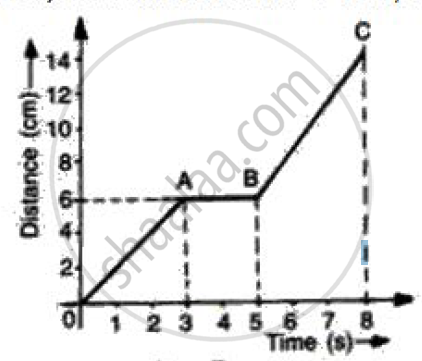
Speed is a ______ quantity whereas velocity is a ______ quantity.
Distances between two cities are measured in kilometres.
The cheetah the fastest animal among terrestrial animals run with an average speed of ______.
Why did the actual speed differ from the average, speed?
A car starting from rest moves with a uniform acceleration of 0.2 ms-2 for 3 min. Find the
- speed acquired
- the distance traveled.
Abus from Chennai travels to Trichy passes loo km, 160 km at 10.15 am, 11.15 am respectively. Find the average speed of the bus during 10.15 – 11.15 am.
