Advertisements
Advertisements
प्रश्न
A 50 m long train passes over a bridge at a speed of 30 km/h. If it takes 36 seconds to cross the bridge, calculate the length of the bridge.
Advertisements
उत्तर
Speed of train = 30 km/hr.
Speed in m/s = ( 30 X1000 )/3600 = 50/6 m/s.
Length of train = 50 m.
Let the length of the bridge be s metre.
The train has to cover a total distance of 50 +s to cross that bridge.
Time taken by train to cover this distance = 36 sec.
So as time taken = total distance /total time taken.
36 = ( 50 +s ) X 6/ 50.
1800 = 300 + 6s
6s = 1500.
S = 1500/6 = 250m
Length of bridge is 250 m.
APPEARS IN
संबंधित प्रश्न
What is the difference between distance travelled by a body and its displacement ? Explain with the
help of a diagram.
Define displacement. State its unit.
Differentiate between distance and displacement.
What can you say about the nature of motion of a body if its displacement-time graph is A straight line inclined to the time axis with an acute angle?
A body is moving in a straight line and its displacement at various instants of time is given in the following table
| Time (s) | 0 | 1 | 2 | 3 | 4 | 5 | 6 | 7 |
| Displacement (m) | 2 | 6 | 12 | 12 | 12 | 18 | 22 | 24 |
Plot the displacement-time graph and calculate
(i) Total distance travelled in the interval 1 s to 5 s.
(ii) Average velocity in time interval 1 s to 5 s.
From the displacement-time graph of a cyclist given below in the Figure, find The displacement from the initial position at the end of 10 s,
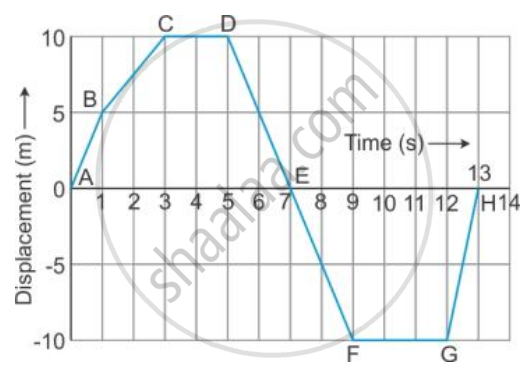
Calculate the distance and displacement in the following case: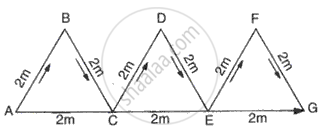
The table below shows the distance travelled by two vehicles A and B during each second:
| Time (s) | 0 | 1 | 2 | 3 | 4 | 5 | 6 | 7 |
| Distance travelled by A (m) | 0 | 20 | 80 | 180 | 240 | 300 | 360 | 420 |
| Distance travelled by B (m) | 0 | 10 | 40 | 90 | 160 | 250 | 360 | 490 |
Which vehicle is moving with a constant acceleration?
A particle is moving in a circular path of radius r. The displacement after half a circle would be
A man leaves his house at 6.30 a.m. for a morning walk and returns back at 7.30 a.m. after covering 4 km. The Displacement covered by him is ______.
