Advertisements
Advertisements
प्रश्न
Which of the following is true for displacement?
- It cannot be zero.
- Its magnitude is greater than the distance travelled by the object.
Advertisements
उत्तर
- False
Displacement can become zero when the initial and final positions of the object are the same. - False
Displacement is the shortest measurable distance between the initial and final positions of an object. It cannot be greater than the magnitude of the distance travelled by an object. However, sometimes it may be equal to the distance travelled by the object.
संबंधित प्रश्न
An ant travels a distance of 8 cm from P to Q and then moves a distance of 6 cm at right angles to PQ. Find its resultant displacement.
A body travels a distance of 3 km towards East, then 4 km towards North and finally 9 km towards East.
What is the total distance travelled ?
The numerical ratio of displacement to distance for a moving object is :
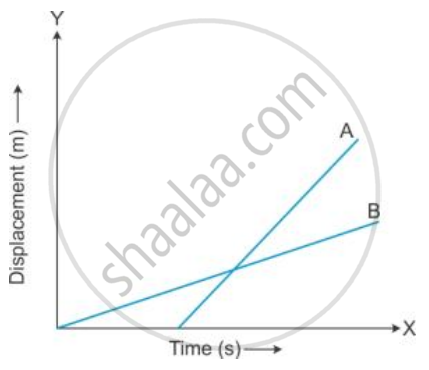
Figure shows the displacement-time graph of two vehicles A and B moving along a straight road. Which vehicle is moving faster? Give reason.
A body starts from rest with uniform acceleration 2 m s-2. Find the distance covered by the body in 2 s.
When brakes are applied to a bus, retardation produced is 25 cm s-2 and the bus takes 20 s to stop. Calculate -
- The initial velocity of the bus
- The distance travelled by bus during this time.
A car covers 90 km in `1 1/2` hours towards east. Calculate
- displacement of car,
- its velocity in (a) kmh−1 (b) ms−1.
A satellite makes a complete round along its circular orbit. What is its displacement?
Give some examples for vector quantity.
Displacement magnitude can be greater than the distance traveled by the object.
