Advertisements
Advertisements
प्रश्न
A car covers 90 km in `1 1/2` hours towards east. Calculate
- displacement of car,
- its velocity in (a) kmh−1 (b) ms−1.
Advertisements
उत्तर
(i) A car covers 90 km in `1 1/2` hour i.e. `3/2` hour towards east.
∴ Displacement = 90 km − east
(ii) Time = `1 1/2` hour = `3/2` hour
Velocity = `"Displacement"/"Time"`
v = `90/(3//2)`
v = `(90xx2)/3` = 60 km/h
v = `60xx1000/3600` m/s
v = `100/6` m/s = 16.67 ms−1
APPEARS IN
संबंधित प्रश्न
The displacement of a moving object in a given interval of time is zero. Would the distance travelled by the object also be zero ? Give reason for your answer.
State how the velocity-time graph can be used to find The distance travelled by the body in a given time
A car starting from rest accelerates uniformly to acquire a speed 20 km h-1 in 30 min. The distance travelled by a car in this time interval will be _____________
Draw displacement – time graph for the following situation:
When a body is moving with variable velocity.
How can you find the following?
Displacement from velocity – time graph.
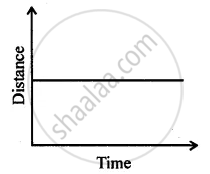
Can you suggest the kind of motion of a body from the following distance – time graph?
A body is moving along a circular path of radius r. What will be the distance and displacement of the body when it completes:
Two full revolutions
A body moves along a circular path of radius r. When it completes three complete rounds, what is the ratio of distance covered to its displacement?
Which of the following is correct?
Slope of a velocity-time graph gives
