Advertisements
Advertisements
प्रश्न
A body is moving along a circular path of radius r. What will be the distance and displacement of the body when it completes:
Two full revolutions
Advertisements
उत्तर
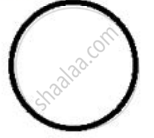
Distance travelled is two times the perimeter of cirle.
So distance travelled is =4π r.
Displacement =0 as starting and ending point are coinciding.
APPEARS IN
संबंधित प्रश्न
The displacement of a moving object in a given interval of time is zero. Would the distance travelled by the object also be zero ? Give reason for your answer.
State how the velocity-time graph can be used to find The distance travelled by the body in a given time
A body at rest is made to fall from the top of a tower. Its displacement at different instants is given in the following table:
| Time (in s) | 0.1 | 0.2 | 0.3 | 0.4 | 0.5 | 0.6 |
| Displacement (in m) | 0.05 | 0.20 | 0.45 | 0.80 | 1.25 | 1.80 |
Draw a displacement-time graph and state whether the motion is uniform or non-uniform?
Under what condition is the displacement of a body equal to the distance traveled by it?
An object is thrown vertically upwards. It rises upto a height H and then returns to its initial position. Calculate
The total distance traveled by the object
The table below shows the distance travelled by two vehicles A and B during each second:
| Time (s) | 0 | 1 | 2 | 3 | 4 | 5 | 6 | 7 |
| Distance travelled by A (m) | 0 | 20 | 80 | 180 | 240 | 300 | 360 | 420 |
| Distance travelled by B (m) | 0 | 10 | 40 | 90 | 160 | 250 | 360 | 490 |
Which vehicle is moving with uniform velocity?
The table below shows the distance travelled by two vehicles A and B during each second:
| Time (s) | 0 | 1 | 2 | 3 | 4 | 5 | 6 | 7 |
| Distance travelled by A (m) | 0 | 20 | 80 | 180 | 240 | 300 | 360 | 420 |
| Distance travelled by B (m) | 0 | 10 | 40 | 90 | 160 | 250 | 360 | 490 |
Which vehicle is moving with a constant acceleration?
The shortest distance between two places is ______.
Distance travelled by a body in a given time ______.
Slope of a velocity-time graph gives
