Advertisements
Advertisements
प्रश्न
Which of the following is true for displacement?
- It cannot be zero.
- Its magnitude is greater than the distance travelled by the object.
Advertisements
उत्तर
- False
Displacement can become zero when the initial and final positions of the object are the same. - False
Displacement is the shortest measurable distance between the initial and final positions of an object. It cannot be greater than the magnitude of the distance travelled by an object. However, sometimes it may be equal to the distance travelled by the object.
संबंधित प्रश्न
The numerical ratio of displacement to distance for a moving object is :
What information about the motion of a body are obtained from the displacement-time graph?
How is the distance related with time for motion under uniform acceleration such as the motion of a freely falling body?
Can you suggest the kind of motion of a body from the following distance – time graph?
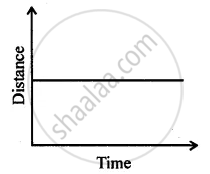
A motorbike running at 90 kmh−1, is slowed down to 54 kmh−1 by the application of brakes, over a distance of 40 m. If the brakes are applied with the same force, calculate
- total time in which bike comes to rest
- total distance travelled by bike.
Under what condition is the displacement of a body equal to the distance traveled by it?
Calculate the distance and displacement in the following case: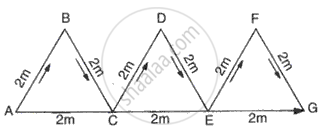
A satellite makes a complete round along its circular orbit. What is its displacement?
Assertion: Displacement of a body may be zero when distance travelled by it is not zero.
Reason: The displacement is the shortest distance between initial and final position.
Assertion: If the displacement of the body is zero, the distance covered by it may not be zero.
Reason: Displacement is a vector & distance is a scalar quantity.
