Advertisements
Advertisements
प्रश्न
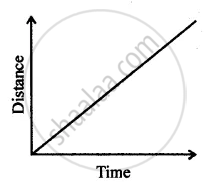
Can you suggest the kind of motion of a body from the following distance – time graph?
Advertisements
उत्तर
Distance – time graph in the figure shows that body is in uniform motion.
APPEARS IN
संबंधित प्रश्न
The numerical ratio of displacement to distance for a moving object is :
In which of the following cases of motion, the distance moved and the magnitude of displacement are equal?
Differentiate between distance and displacement.
What can you say about the nature of motion of a body if its displacement-time graph is A straight line inclined to the time axis with an obtuse angle?
Copy the following table and fill in the blank spaces.
| Quantity | S.I. Unit | Scalar or Vector |
| Displacement | ___________ | ___________ |
Give the name of the physical quantity that corresponds to the rate of change of displacement.
Fill in the boxes.
| S.No | First Move | Seconde Move | Distance (m) | Displacement |
| 1. | Move 4 metres east | Move 2 metres west | 6 | 2 m east |
| 2. | Move 4 metres north | Move 2 metres south | ||
| 3. | Move 2 metres east | Move 4 metres west | ||
| 4. | Move 5 metres east | Move 5 metres west | ||
| 5. | Move 5 metres south | Move 2 metres north | ||
| 6. | Move 10 metres west | Move 3 metres east |
Exercise Problems.
An athlete completes one round of a circular track of diameter 200 m in 40 s. What will be the distance covered and the displacement at the end of 2 m and 20 s?
A particle is moving in a circular pattern of radius r. The displacement after half a circle would be ______.
The displacement covered by the second hand of radius V in a clock after one revolution is ______.
