Advertisements
Advertisements
Question
Four cars A, B, C, and D are moving on a levelled road. Their distance versus time graphs are shown in Fig. 8.2. Choose the correct statement.

Options
Car A is faster than car D.
Car B is the slowest.
Car D is faster than car C.
Car C is the slowest
Advertisements
Solution
Car B is the slowest.
As speed, v = `("S"_2 - "S"_1)/("t"_2 - "t"_1)`
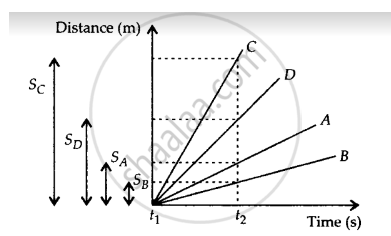
For the same time interval (t2 − t1), the distance travelled by cars A, B, C, and D are in the order SC > SD > SA > SB
∴ Car C is the fastest and car B is the slowest.
APPEARS IN
RELATED QUESTIONS
Which of the following is true for displacement?
- It cannot be zero.
- Its magnitude is greater than the distance travelled by the object.
Is displacement a scalar quantity?
What information about the motion of a body are obtained from the displacement-time graph?
Draw displacement – time graph for the following situation:
When a body is moving with variable velocity.
Ashok starts from his house and travels 3 km to reach his school. On finding the school gates closed, he returns to his house. What is?
The displacement of Ashok
A 50 m long train passes over a bridge at a speed of 30 km/h. If it takes 36 seconds to cross the bridge, calculate the length of the bridge.
The table below shows the distance travelled by two vehicles A and B during each second:
| Time (s) | 0 | 1 | 2 | 3 | 4 | 5 | 6 | 7 |
| Distance travelled by A (m) | 0 | 20 | 80 | 180 | 240 | 300 | 360 | 420 |
| Distance travelled by B (m) | 0 | 10 | 40 | 90 | 160 | 250 | 360 | 490 |
Which vehicle is moving with uniform velocity?
Which of the following figures represent uniform motion of a moving object correctly?
The SI unit of displacement is ______.
A particle is moving in a circular pattern of radius r. The displacement after half a circle would be ______.
