Advertisements
Advertisements
Question
Obtain a relation for the distance travelled by an object moving with uniform acceleration in the interval between 4th and 5th seconds.
Advertisements
Solution
Let the object be moving with initial velocity u ms−1 and uniform acceleration an ms−2
∴ The distance travelled by the moving object
in ts is, s = `"ut" + 1/2 "at"^2`
Now distance travelled in 4s,
s4 = `"u" xx 4 + 1/2 "a" xx 4^2`
= 4u + 8a
Distance travelled in 5s
s5 = `"u" xx 5 + 1/2 "a" xx 5^2`
= `5"u" + 25/2 "a"`
∴ Distance travelled in the interval between 4th and 5th second
= `(5"u" + 25/2 "a") - (4"u" + 8"a")`
= `("u" + 9/2"a")"m"`
APPEARS IN
RELATED QUESTIONS
If on a round trip you travel 6 km and then arrive back home :
What is your final displacement ?
The numerical ratio of displacement to distance for a moving object is :
What can you say about the nature of motion of a body if its displacement-time graph is A straight line inclined to the time axis with an acute angle?
How is the distance related with time for motion under uniform acceleration such as the motion of a freely falling body?
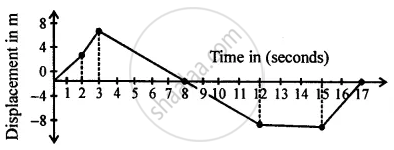
From the displacement – time graph shown given below calculate:
- Average velocity in the first three seconds.
- Displacement from the initial position at the end of 13 s.
- Time after which the body is at the initial position,
- Average velocity after 8 s.
Write two differences between distance and displacement.
Calculate the distance and displacement in the following case: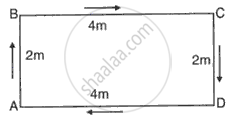
A car travels at a uniform speed of 42 km/h. In 10 minutes, how much distance would it cover?
Displacement / Time : Velocity :: Speed / Time : ______.
Slope of a velocity-time graph gives
