Advertisements
Advertisements
Question
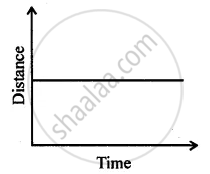
Can you suggest the kind of motion of a body from the following distance – time graph?
Advertisements
Solution
Distance – time graph in the figure shows that body is stationary.
APPEARS IN
RELATED QUESTIONS
What can you say about the nature of motion of a body if its displacement-time graph is A straight line parallel to the time axis?
Figure (a) shows the velocity-time graph for the motion of a body. Use it to find the displacement of the body at t = 1 s, 2 s, 3 s and 4 s, then draw on Figure (b), the displacement-time graph for it.
 |
 |
| (a) | (b) |
A body starts from rest with uniform acceleration 2 m s-2. Find the distance covered by the body in 2 s.
Draw displacement – time graph for the following situation:
When a body is moving with variable velocity.
How can you find the following?
Velocity from a displacement – time graph.
Write the SI units for measurement of distance and displacement.
A 50 m long train passes over a bridge at a speed of 30 km/h. If it takes 36 seconds to cross the bridge, calculate the length of the bridge.
The SI unit of displacement is ______.
Slope of a velocity-time graph gives
Displacement is the ______ distance covered by a body.
