Advertisements
Advertisements
Question
A body starts with an initial velocity of 10m s-1 and acceleration 5 m s-2. Find the distance covered by it in 5 s.
Advertisements
Solution
Initial velocity u = 10 m/s
Acceleration a = 5 m/s2
Time t = 5s
Let 'S' be the distance covered.
Using the second equation of motion,
S = ut + (1/2) at2
S = (10)(5) + (1/2) (5) (5) 2
S = 50 + 62.5
S = 112.5 m
APPEARS IN
RELATED QUESTIONS
An athlete completes one round of a circular track of diameter 200 m in 40 s. What will be the distance covered and the displacement at the end of 2 minutes 20 s?
State how the velocity-time graph can be used to find The distance travelled by the body in a given time
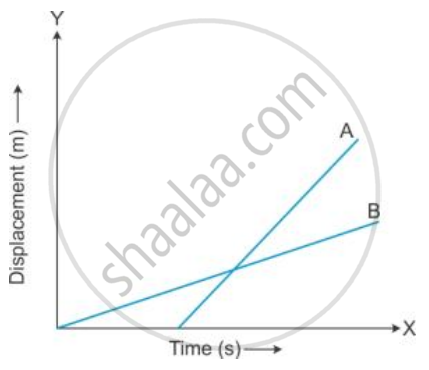
Figure shows the displacement-time graph of two vehicles A and B moving along a straight road. Which vehicle is moving faster? Give reason.
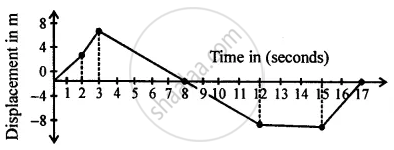
From the displacement – time graph shown given below calculate:
- Average velocity in the first three seconds.
- Displacement from the initial position at the end of 13 s.
- Time after which the body is at the initial position,
- Average velocity after 8 s.
Can distance covered by a body be less than the magnitude of its displacement?
A body is moving along a circular path of radius r. What will be the distance and displacement of the body when it completes:
Full revolution
The graph shows how the velocity of a scooter varies with time in 50 s.
Work out: The distance traveled in 10 s, 20 s, and 50 s.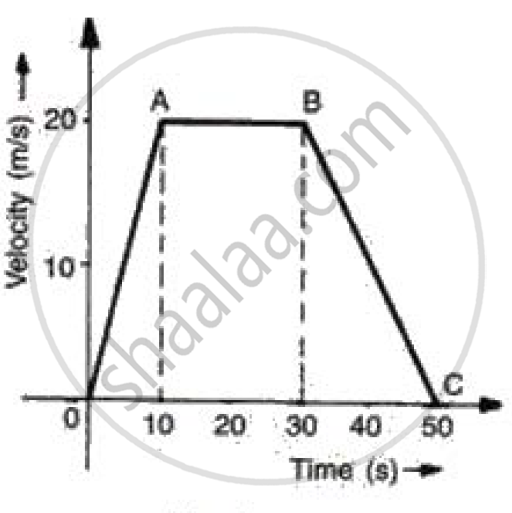
A particle is moving in a circular path of radius r. The displacement after half a circle would be
In which of the following cases of motions, the distance moved and the magnitude of displacement are equal?
An ant moves from one corner of a room diagonally to the opposite corner. If the dimensions of the hall are 8m x 6m, the displacement of the ant is ______.
