Advertisements
Advertisements
Question
Under what conditions can a body travel a certain distance and yet its resultant displacement be zero ?
Advertisements
Solution
When the body comes back to its starting point, its resultant displacement is zero. It is because it has covered a certain distance in due course of time; however, there is no difference between the initial and final positions.
APPEARS IN
RELATED QUESTIONS
Clarify the difference.
Distance and displacement
Figure given below shows a velocity-time graph for a car starting from rest. The graph has three parts AB, BC and CD.
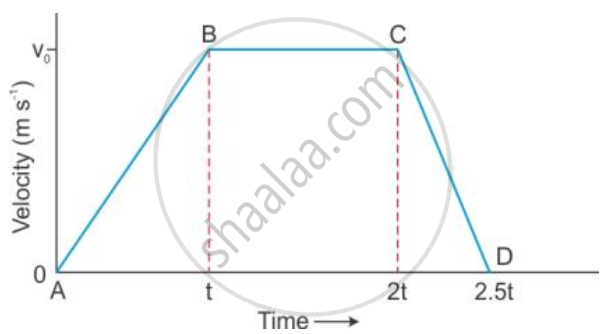
Compare the distance travelled in part BC with the distance travelled in part AB.
A car starting from rest accelerates uniformly to acquire a speed 20 km h-1 in 30 min. The distance travelled by a car in this time interval will be _____________
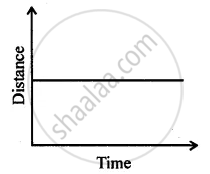
Can you suggest the kind of motion of a body from the following distance – time graph?
Ashok starts from his house and travels 3 km to reach his school. On finding the school gates closed, he returns to his house. What is?
The distance traveled by Ashok.
Give the name of the physical quantity that corresponds to the rate of change of displacement.
Displacement / Time : Velocity :: Speed / Time : ______.
Geetha takes 15 minutes from her house to reach her school on a bicycle. If the bicycle has a speed of 2 m/s, calculate the distance between her house and the school.
The displacement covered by the second hand of radius V in a clock after one revolution is ______.
Choose the correct option.
