Advertisements
Advertisements
Question
The figure represents graphically the velocity of a car moving along a straight road over a period of 100 hours.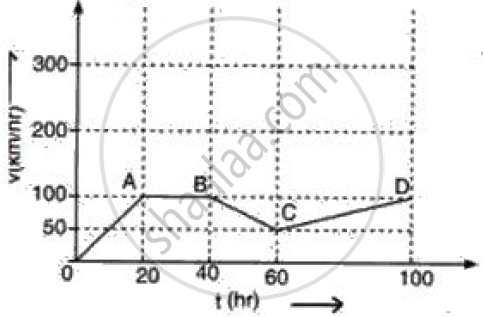
Calculate the distance travelled in the last 40 h.
Advertisements
Solution
Distance travelled in last 40 hour would be equal to area under graph during that time = 50 x (100 - 60) + `1/2`x(100 - 60) x(100 - 50).
S = 2000 + 1000 = 3000 km.
APPEARS IN
RELATED QUESTIONS
State whether distance is a scalar or a vector quantity.
A particle is moving in a circular path of radius r. The displacement after half a circle would be :
The numerical ratio of displacement to distance for a moving object is :
State how the velocity-time graph can be used to find The distance travelled by the body in a given time
State how the velocity-time graph can be used to find The displacement of the body in a given time.
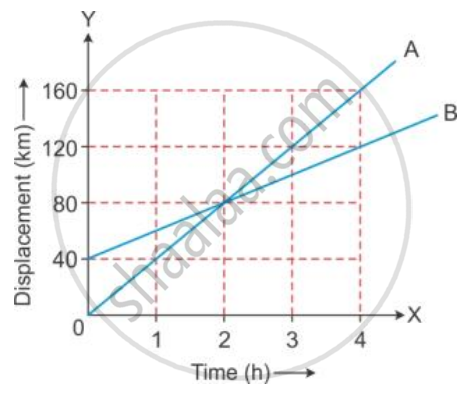
Figure ahead represents the displacement - time sketch of motion of two cars A and B . Find :
(i) the distance by which the car B was initially ahead of car A.
(ii) the velocities of car A and car B.
(iii) the time in which car A catches car B.
(iv) the distance from start when the car A will catch the car B.
Define Displacement.
Calculate the distance and displacement in the following case: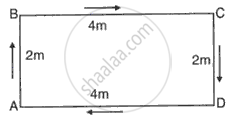
A body moves along a circular path of radius r. When it completes three complete rounds, what is the ratio of distance covered to its displacement?
Is displacement a scalar quantity?
