Advertisements
Advertisements
Question
A body is moving along a circular path of radius R. What will be the distance travelled and displacement of the body when it completes half a revolution ?
Advertisements
Solution
We have to analyse the distance and displacement of a body that has covered half the perimeter of a circle.
Distance travelled in half a rotation of a circular path is equal to the circumference of semi-circle.
Distance travelled = πR
Displacement is calculated from the initial and final positions of a body. It is independent of the path covered. So, displacement is the diameter of the semi-circle.
Hence, displacement is 2R, where R is the radius of the circular path.
APPEARS IN
RELATED QUESTIONS
Which of the following is true for displacement?
- It cannot be zero.
- Its magnitude is greater than the distance travelled by the object.
A boy walks from his classroom to the bookshop along a straight corridor towards North. He covers a distance of 20 m in 25 seconds to reach the bookshop. After buying a book, he travels the same distance in the same time to reach back in the classroom. Find (a) average speed, and (b) average velocity, of the boy.
The minimum distance between the start and finish points of the motion of an object is called the ______ of the object.
From the displacement-time graph of a cyclist given below in the Figure, find The displacement from the initial position at the end of 10 s,
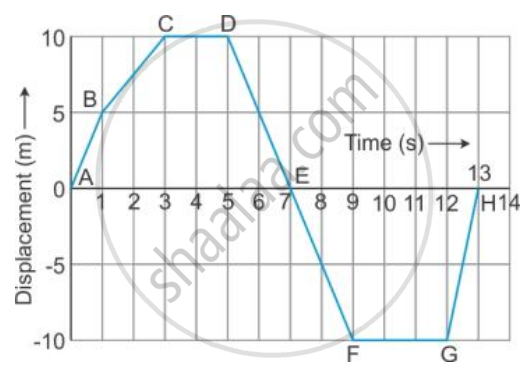
A ball moves on a smooth floor in a straight line with uniform velocity 10 m s-1 for 6 s. At t = 6 s, the ball hits a wall and comes back along the same line to the starting point with the same speed. Draw the velocity-time graph and use it to find the total distance travelled by the ball and its displacement.
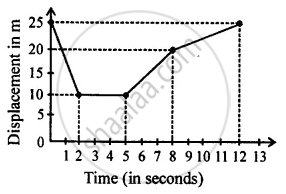
From the displacement – time graph shown given below calculate :
- Velocity between 0 – 2 s.
- Velocity between 8 s – 12 s.
- Average velocity between 5 s – 12 s.
An object is thrown vertically upwards. It rises upto a height H and then returns to its initial position. Calculate
The total distance traveled by the object
The graph shows how the velocity of a scooter varies with time in 50 s.
Work out: The distance traveled in 10 s, 20 s, and 50 s.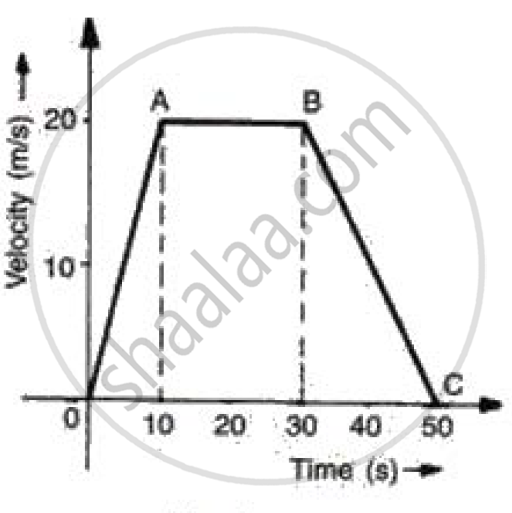
An object is dropped from rest at a height of 150 m and simultaneously another object is dropped from rest at a height of 100 m. What is the difference in their heights after 2s if both the objects drop with the same accelerations? How does the difference in heights vary with time?
If the displacement-time graph of a particle is parallel to the time axis, the velocity of the particle is ______.
