Advertisements
Advertisements
Question
A particle is moving in a circular path of radius r. The displacement after half a circle would be :
Options
0
`pir`
2r
`2pir`
Advertisements
Solution
2r
Displacement is the difference between the final and initial position of a body. It is a vector quantity and is independent of the path taken. So, for the movement of half of a circle, the displacement is 2r, where r is the radius of the circular path.
APPEARS IN
RELATED QUESTIONS
Clarify the difference.
Distance and displacement
State how the velocity-time graph can be used to find The distance travelled by the body in a given time
Copy the following table and fill in the blank spaces.
| Quantity | S.I. Unit | Scalar or Vector |
| Displacement | ___________ | ___________ |
Calculate the distance and displacement in the following case: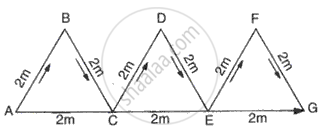
An object covers a distance of S meters in t seconds as follows :
| S (meters) | 0 | 8 | 20 | 20 | 16 | 10 | 0 |
| t (Seconds) | 80 | 2 | 5 | 10 | 12 | 15 | 10 |
Plot a graph, taking t on X-axis and S on Y-axis. Determine the velocity of the object at time
(i) 6 s, and
(ii) 14 s.
A particle is moving in a circular path of radius r. The displacement after half a circle would be
The shortest distance between two places is ______.
State whether true or false. If false, correct the statement.
Distance covered by a particle never becomes zero but displacement becomes zero.
An ant moves from one corner of a room diagonally to the opposite corner. If the dimensions of the hall are 8m x 6m, the displacement of the ant is ______.
Distance travelled by a freely falling body is proportional to ______.
