Advertisements
Advertisements
Question
State how the velocity-time graph can be used to find The distance travelled by the body in a given time
Advertisements
Solution
The total distance travelled by a body in a given time is given by the area enclosed between the velocity-time graph and X-axis (without any sign).
APPEARS IN
RELATED QUESTIONS
Which of the following is true for displacement?
- It cannot be zero.
- Its magnitude is greater than the distance travelled by the object.
A boy walks from his classroom to the bookshop along a straight corridor towards North. He covers a distance of 20 m in 25 seconds to reach the bookshop. After buying a book, he travels the same distance in the same time to reach back in the classroom. Find (a) average speed, and (b) average velocity, of the boy.
If the displacement of an object is proportional to the square of time, then the object is moving with :
Can displacement-time sketch be parallel to the displacement axis? Give a reason to your answer.
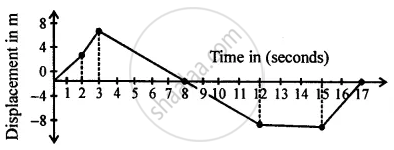
From the displacement – time graph shown given below calculate:
- Average velocity in the first three seconds.
- Displacement from the initial position at the end of 13 s.
- Time after which the body is at the initial position,
- Average velocity after 8 s.
Write the SI units for measurement of distance and displacement.
Give the name of the physical quantity that corresponds to the rate of change of displacement.
Assertion: Displacement of a body may be zero when distance travelled by it is not zero.
Reason: The displacement is the shortest distance between initial and final position.
Distance travelled by a body in a given time ______.
Slope of a velocity-time graph gives
