Advertisements
Advertisements
Question
A body at rest is made to fall from the top of a tower. Its displacement at different instants is given in the following table:
| Time (in s) | 0.1 | 0.2 | 0.3 | 0.4 | 0.5 | 0.6 |
| Displacement (in m) | 0.05 | 0.20 | 0.45 | 0.80 | 1.25 | 1.80 |
Draw a displacement-time graph and state whether the motion is uniform or non-uniform?
Advertisements
Solution
The displacement-time graph is given below:
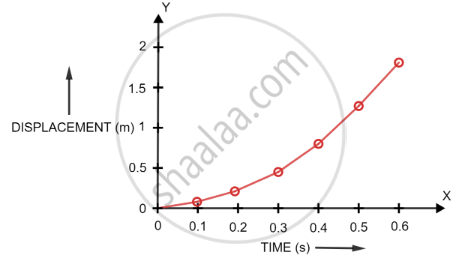
When we observe the graph, we find, that the displacement-time graph is a curve.
Hence, we can say that the motion is non-uniform.
APPEARS IN
RELATED QUESTIONS
Which of the following is true for displacement?
- It cannot be zero.
- Its magnitude is greater than the distance travelled by the object.
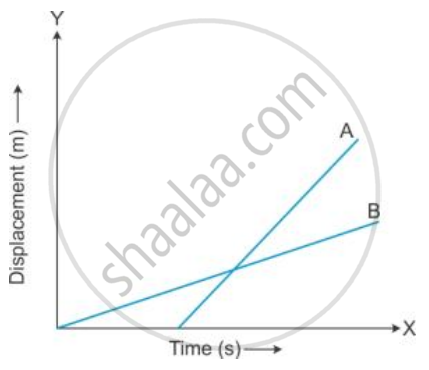
Figure shows the displacement-time graph of two vehicles A and B moving along a straight road. Which vehicle is moving faster? Give reason.
How is the distance related with time for motion under uniform acceleration such as the motion of a freely falling body?
Calculate the distance and displacement in the following case: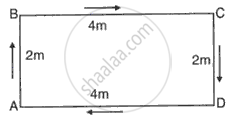
An object is thrown vertically upwards. It rises upto a height H and then returns to its initial position. Calculate
The total distance traveled by the object
Which of the following figures represent uniform motion of a moving object correctly?
Displacement / Time : Velocity :: Speed / Time : ______.
Choose the correct option.
Displacement magnitude can be greater than the distance traveled by the object.
Assertion: If the displacement of the body is zero, the distance covered by it may not be zero.
Reason: Displacement is a vector & distance is a scalar quantity.
