Advertisements
Advertisements
Question
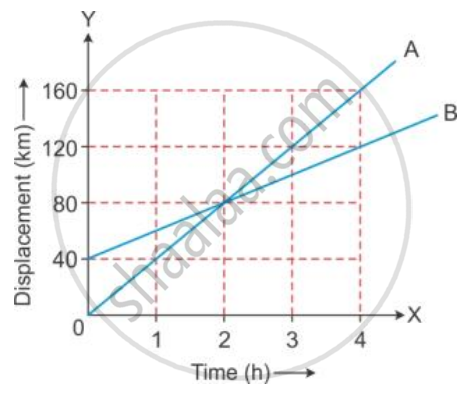
Figure ahead represents the displacement - time sketch of motion of two cars A and B . Find :
(i) the distance by which the car B was initially ahead of car A.
(ii) the velocities of car A and car B.
(iii) the time in which car A catches car B.
(iv) the distance from start when the car A will catch the car B.
Advertisements
Solution
(i) Initially, the car B was 40 km ahead of car A.
(ii) Straight line depicts that cars A and B are moving with uniform velocities.
For car A
Displacement at t = 1 h is 40 m
Velocity = Displacement /time
= (40/1) km/h
= 40 km/h-1
For car B
Displacement at t = 4 h is (120 - 40) km, i.e. 80 km
Velocity = Displacement /time
= (80/4) km/h
= 20 km/h-1
(iii) Car A catches car B in 2 hours.
(iv) After starting, car A will catch car B at 80 km.
APPEARS IN
RELATED QUESTIONS
State how the velocity-time graph can be used to find The distance travelled by the body in a given time
How is the distance related with time for motion under uniform acceleration such as the motion of a freely falling body?
A bird sitting on a wire, flies, circles around and comes back to its perch. Explain the total distance it traversed during its flight and its eventual displacement.
Give two differences between displacement and distance.
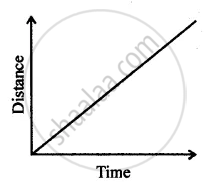
Can you suggest the kind of motion of a body from the following distance – time graph?
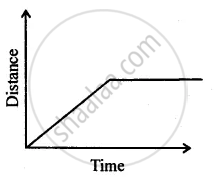
Can you suggest the kind of motion of a body from the following distance – time graph?
A satellite makes a complete round along its circular orbit. What is its displacement?
Displacement / Time : Velocity :: Speed / Time : ______.
Four cars A, B, C, and D are moving on a levelled road. Their distance versus time graphs are shown in Fig. 8.2. Choose the correct statement.

The SI unit of displacement is ______.
