Advertisements
Advertisements
प्रश्न
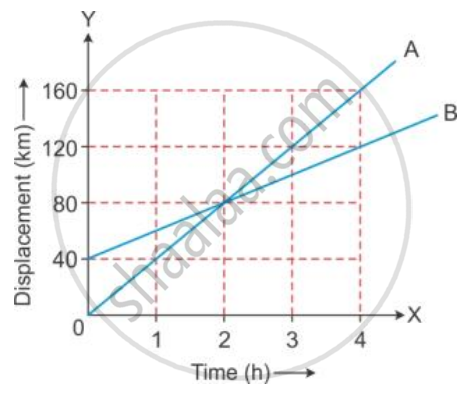
Figure ahead represents the displacement - time sketch of motion of two cars A and B . Find :
(i) the distance by which the car B was initially ahead of car A.
(ii) the velocities of car A and car B.
(iii) the time in which car A catches car B.
(iv) the distance from start when the car A will catch the car B.
Advertisements
उत्तर
(i) Initially, the car B was 40 km ahead of car A.
(ii) Straight line depicts that cars A and B are moving with uniform velocities.
For car A
Displacement at t = 1 h is 40 m
Velocity = Displacement /time
= (40/1) km/h
= 40 km/h-1
For car B
Displacement at t = 4 h is (120 - 40) km, i.e. 80 km
Velocity = Displacement /time
= (80/4) km/h
= 20 km/h-1
(iii) Car A catches car B in 2 hours.
(iv) After starting, car A will catch car B at 80 km.
APPEARS IN
संबंधित प्रश्न
What is the difference between distance travelled by a body and its displacement ? Explain with the
help of a diagram.
A body is moving along a circular path of radius R. What will be the distance travelled and displacement of the body when it completes half a revolution ?
If the displacement of an object is proportional to the square of time, then the object is moving with :
Differentiate between distance and displacement.
When is the magnitude of displacement equal to the distance?
Draw a velocity-time graph for a body moving with an initial velocity u and uniform acceleration a. Use this graph to find the distance travelled by the body in time t.
The following table gives the displacement of a car at different instants of time.
| Time (s) | 0 | 1 | 2 | 3 | 4 |
| Displacement (m) | 0 | 5 | 10 | 15 | 20 |
- Draw the displacement-time sketch and find the average velocity of the car.
- What will be the displacement of the car at (i) 2.5 s and (ii) 4.5 s?
A body moves along a circular path of radius r. When it completes three complete rounds, what is the ratio of distance covered to its displacement?
The graph shows how the velocity of a scooter varies with time in 50 s.
Work out: The distance traveled in 10 s, 20 s, and 50 s.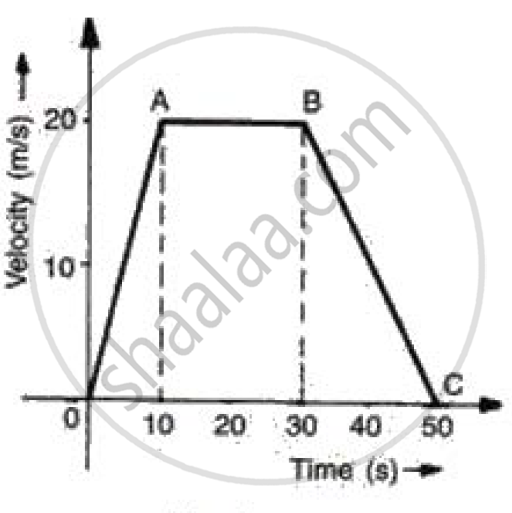
An object is dropped from rest at a height of 150 m and simultaneously another object is dropped from rest at a height of 100 m. What is the difference in their heights after 2s if both the objects drop with the same accelerations? How does the difference in heights vary with time?
