Advertisements
Advertisements
प्रश्न
An object is dropped from rest at a height of 150 m and simultaneously another object is dropped from rest at a height of 100 m. What is the difference in their heights after 2s if both the objects drop with the same accelerations? How does the difference in heights vary with time?
Advertisements
उत्तर

Initially, the difference in heights of two objects
= 150 m – 100 m
= 50 m
Distance travelled by the first object in 2s
h = `"ut" + 1/2 "at"^2`
= `0 + 1/2 xx 10 xx 2 xx 2`
= 20 m
Distance travelled by the second object in 2s,
h' = `"ut" + 1/2 "at"^2`
= `0 + 1/2 xx 10 xx 2 xx 2`
= 20 m
Height of first object from ground at t = 2s
= 150 m − 20 m
= 130 m
Height of second object from ground t = 2s
= 100 m − 20 m
= 80 m
∴ Difference in height after t = 2s
= 130m − 80 m
= 50 m
The difference in heights does not vary with time as long as both the objects are in motion. However, when the second object reaches the ground and the first one is still in motion, then it decreases.
APPEARS IN
संबंधित प्रश्न
A boy walks from his classroom to the bookshop along a straight corridor towards North. He covers a distance of 20 m in 25 seconds to reach the bookshop. After buying a book, he travels the same distance in the same time to reach back in the classroom. Find (a) average speed, and (b) average velocity, of the boy.
A particle is moving in a circular path of radius r. The displacement after half a circle would be :
Differentiate between distance and displacement.
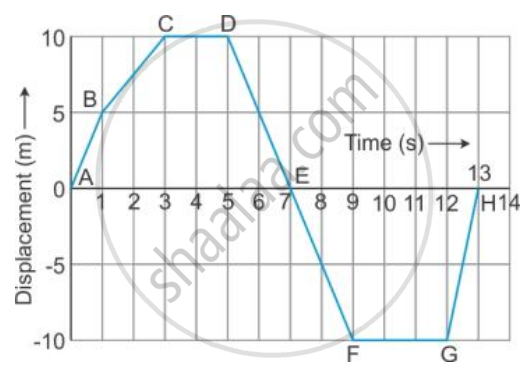
From the displacement-time graph of a cyclist given below in the Figure, find The displacement from the initial position at the end of 10 s,
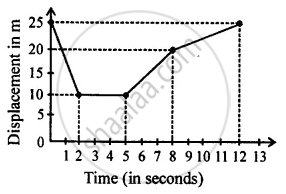
From the displacement – time graph shown given below calculate :
- Velocity between 0 – 2 s.
- Velocity between 8 s – 12 s.
- Average velocity between 5 s – 12 s.
The table below shows the distance travelled by two vehicles A and B during each second:
| Time (s) | 0 | 1 | 2 | 3 | 4 | 5 | 6 | 7 |
| Distance travelled by A (m) | 0 | 20 | 80 | 180 | 240 | 300 | 360 | 420 |
| Distance travelled by B (m) | 0 | 10 | 40 | 90 | 160 | 250 | 360 | 490 |
Give the value of the velocity at which they are meeting
A car starts from rest and moves along the x-axis with constant acceleration 5 ms–2 for 8 seconds. If it then continues with constant velocity, what distance will the car cover in 12 seconds since it started from the rest?
An ant moves from one corner of a room diagonally to the opposite corner. If the dimensions of the hall are 8m x 6m, the displacement of the ant is ______.
If the displacement-time graph of a particle is parallel to the time axis, the velocity of the particle is ______.
Displacement is the ______ distance covered by a body.
