Advertisements
Advertisements
Question
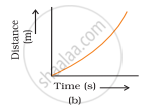
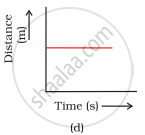
Which of the following figures (Fig. 8.3) represents uniform motion of a moving object correctly?
Options

Advertisements
Solution
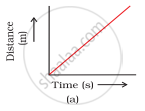
In uniform motion, object covers equal distances in equal intervals of time. Therefore, the distance-time graph must be a straight line inclined to the time axis. Hence, graph (a) is correct.
APPEARS IN
RELATED QUESTIONS
In addition to speed, what else should we know to predict the position of a moving body ?
Convert a speed of 54 km/h into m/s.
Which of the following could not be a unit of speed?
One of the following is not a vector quantity. This one is :
A train takes 2 h to reach station B from station A, and then 3 h to return from station B to station A. The distance between the two stations is 200 km. Find:
The average speed,
The average velocity of the train.
The velocity-time graph of a moving body is given below in Figure
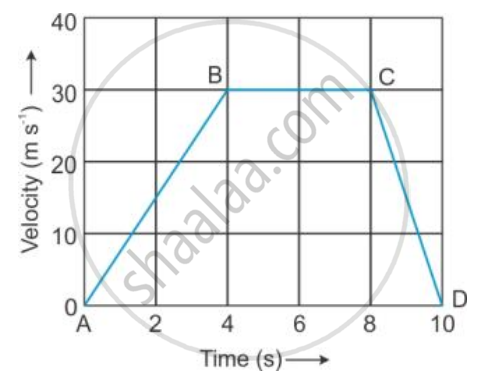
The acceleration in parts AB, BC and CD.
Define variable velocity and give one example.
What is the relation between distance and time when the body is moving with variable velocity?
Give two examples of uniform circular motion from your daily life.
A motorcyclist drives from A to B with a uniform speed of 30 km h–1 and returns back with a speed of 20 km h–1. Find its average speed.
