Advertisements
Advertisements
प्रश्न
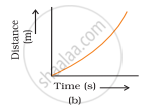
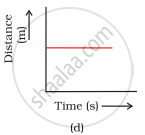
Which of the following figures (Fig. 8.3) represents uniform motion of a moving object correctly?
विकल्प

Advertisements
उत्तर
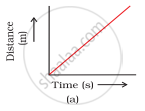
In uniform motion, object covers equal distances in equal intervals of time. Therefore, the distance-time graph must be a straight line inclined to the time axis. Hence, graph (a) is correct.
APPEARS IN
संबंधित प्रश्न
During an experiment, a signal from a spaceship reached the ground station in five minutes. What was the distance of the spaceship from the ground station? The signal travels at the speed of light, that is, 3 × 10⁸m s−1.
Change the speed of 6 m/s into km/h.
What name is given to the speed in a specified direction ?
What do the following measure in a car ?
(a) Speedometer (b) Odometer
State whether speed is a scalar or a vector quantity. Give reason for your choice.
Give one example of a motion where an object does not change its speed but its direction of motion changes continuously.
Which of the following could not be a unit of speed?
The speed of a car is 72 km h-1. Express it in m s-1.
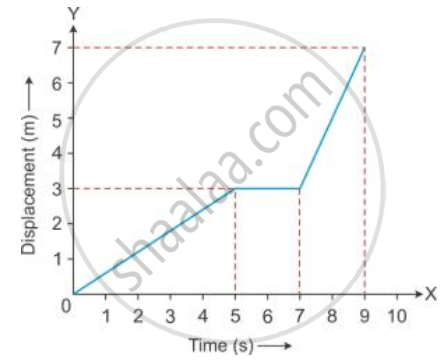
Figure shows the displacement of a body at different times .
Calculate the velocity of the body as it moves for time interval :
(i) 0 to 5 s,
(ii) 5 s to 7 s
(iii) 7 s to 9 s.
A speeding car changes its velocity from 108 kmh−1 to 36 kmh−1 in 4 s. Calculate its deceleration in
- ms−2
- kmh−2.
