Advertisements
Advertisements
Question
The minimum distance between the start and finish points of the motion of an object is called the ______ of the object.
Advertisements
Solution
The minimum distance between the start and finish points of the motion of an object is called the displacement of the object.
Explanation:
Displacement means the shortest distance between the start and end points of the motion. Displacement is a scientific term related to speed and distance. This displacement represents how the body moves from one position to another, that is, the shortest distance between its motion’s start and end points.
APPEARS IN
RELATED QUESTIONS
A body is moving along a circular path of radius R. What will be the distance travelled and displacement of the body when it completes half a revolution ?
If on a round trip you travel 6 km and then arrive back home :
What is your final displacement ?
A body travels a distance of 3 km towards East, then 4 km towards North and finally 9 km towards East.
What is the total distance travelled ?
In which of the following cases of motion, the distance moved and the magnitude of displacement are equal?
Define displacement. State its unit.
Differentiate between distance and displacement.
Can displacement be zero even if the distance is not zero? Give one example to explain your answer.
What information about the motion of a body are obtained from the displacement-time graph?
A bird sitting on a wire, flies, circles around and comes back to its perch. Explain the total distance it traversed during its flight and its eventual displacement.
A motorbike running at 90 kmh−1, is slowed down to 54 kmh−1 by the application of brakes, over a distance of 40 m. If the brakes are applied with the same force, calculate
- total time in which bike comes to rest
- total distance travelled by bike.
Define displacement.
Write two differences between distance and displacement.
Give the name of the physical quantity that corresponds to the rate of change of displacement.
Name the physical quantity associated with the rate of change of displacement with time.
The graph shows how the velocity of a scooter varies with time in 50 s.
Work out: The distance traveled in 10 s, 20 s, and 50 s.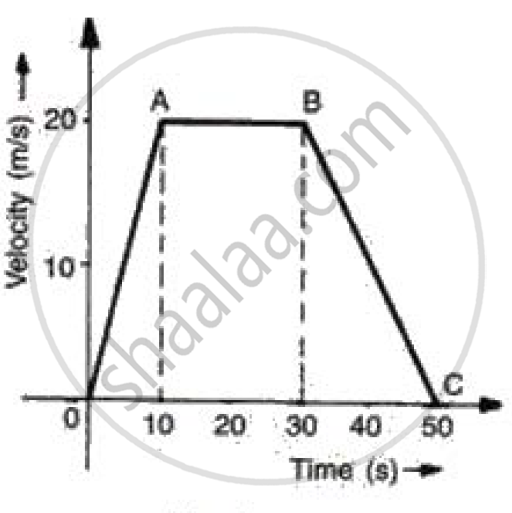
Displacement / Time : Velocity :: Speed / Time : ______.
Give one example where the displacement is zero but the distance travelled is not zero.
A quantity that has both magnitude and direction is ______.
Displacement is the ______ distance covered by a body.
